
Ground effect can improve an airplane’s performance when it operates close to the ground. Understanding how ground effect influences lift, drag, indicated flight instruments, and climb performance is important for safe takeoff operations.
Understanding Ground Effect
Ground effect is a condition of improved performance encountered when an airplane operates very close to the ground. It can normally be detected up to an altitude equal to one wingspan above the surface. [Figure 1]
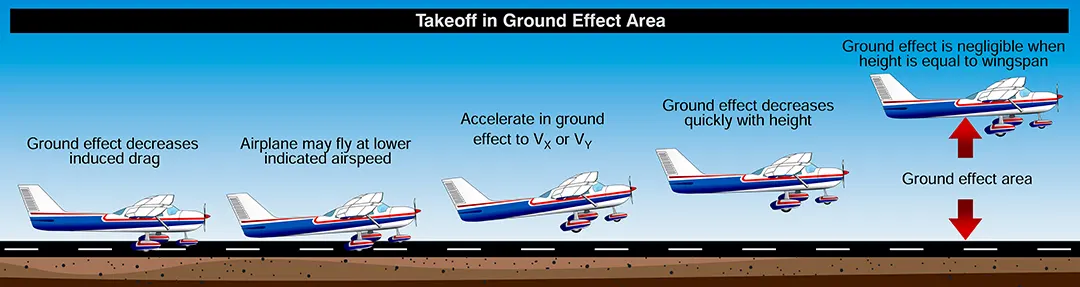
Ground effect is most significant when the airplane maintains a constant attitude at low airspeed and low altitude. Examples include takeoff, when the airplane lifts off and accelerates to climb speed, and landing, during the flare before touchdown.
When the wing is under the influence of ground effect, upwash, downwash, and wingtip vortices are reduced. As a result, induced drag decreases. When the wing is at a height equal to one-quarter of its span, induced drag is reduced by about 25 percent. At a height equal to one-tenth of the span, the reduction is about 50 percent.
At high speeds, where parasite drag dominates, induced drag makes up a smaller part of total drag. Consequently, ground effect is a greater concern during takeoff and landing.
Ground Effect During Takeoff
During takeoff, the takeoff roll, lift-off, and beginning of the initial climb occur within the ground effect area. Ground effect causes local increases in static pressure, which result in the airspeed indicator and altimeter indicating slightly lower values than they should. It usually also causes the vertical speed indicator to indicate a descent.
As the airplane lifts off and climbs out of ground effect, the following changes occur:
- The airplane requires an increase in angle of attack (AOA) to maintain the lift coefficient.
- The airplane experiences an increase in induced drag and thrust required.
- The airplane experiences a pitch-up tendency and requires less elevator travel because of an increase in downwash at the horizontal tail.
- The airplane experiences a reduction in static source pressure and a corresponding increase in indicated airspeed.
Best Angle of Climb and Best Rate of Climb
VX is the speed at which the airplane achieves the greatest gain in altitude for a given distance over the ground. It is usually slightly less than VY, which provides the greatest gain in altitude per unit of time.
The specific speeds for a given airplane are stated in the FAA-approved AFM/POH. The pilot should be aware that, in some airplanes, a deviation of 5 knots from the recommended speed may result in a significant reduction in climb performance. Therefore, precise airspeed control is important to ensure the maneuver is performed safely and successfully.
Ground Effect and Takeoff Performance
Due to the reduced drag in ground effect, the airplane may seem capable of taking off below the recommended airspeed. However, if the airplane climbs out of ground effect below the recommended climb speed, its initial climb performance will be much less than at VY or even VX.
Under conditions of high density altitude, high temperature, and/or maximum gross weight, the airplane may be able to lift off but unable to climb out of ground effect. Consequently, it may not be able to clear obstacles.
Lifting off before attaining the recommended airspeed incurs more drag, requiring more power to overcome it. Since the initial takeoff and climb are based on maximum power, reducing drag is the only option. To reduce drag, pitch must be reduced, which means losing altitude.
Pilots should remember that many airplanes cannot safely take off at maximum gross weight under certain altitude and temperature conditions because of inadequate performance. Therefore, under marginal conditions, it is important to take off at the speed recommended for adequate initial climb performance.
Using Ground Effect to Advantage
Ground effect is important to normal flight operations. If the runway is long enough or no obstacles exist, the pilot can use ground effect to advantage by taking advantage of reduced drag to improve initial acceleration.
When taking off from an unsatisfactory surface, the pilot should apply as much weight to the wings as possible during the ground run and lift-off, using ground effect as an aid before attaining true flying speed. The pilot should reduce AOA to attain normal airspeed before attempting to fly out of the ground effect area.