
Elementary eights are a family of maneuvers in which each individual maneuver involves an airplane tracking a path over the ground that resembles the shape of a figure eight. There are various types of eights, progressing from elementary to advanced maneuvers. Each eight is intended to develop a pilot’s flight control coordination skills, strengthen awareness of the airplane’s position relative to selected ground references, and improve division of attention so that flying becomes more instinctive than mechanical.
Eights require a greater degree of focused attention on selected ground references. However, their real significance is that they help pilots develop the ability to fly with precision.
Elementary eights include eights along a road, eights across a road, and eights around pylons. Each of these maneuvers is a variation of a turn around a point. Each eight uses two ground reference points around which the airplane turns first in one direction and then in the opposite direction, following a figure-eight ground track.
Objectives of Eights Maneuvers
Eights maneuvers are designed for the following purposes:
- Further developing the pilot’s skill in maintaining a specific relationship between the airplane and ground references.
- Improving the pilot’s ability to divide attention between the flightpath, ground-based references, flight control inputs, and scanning for outside hazards and instrument indications during both turning and straight-line flight.
- Developing the pilot’s ability to visualize each segment of the maneuver and the maneuver as a whole before execution.
- Developing the pilot’s ability to intuitively manipulate the flight controls and adjust the bank angle to compensate for groundspeed changes, maintain constant-radius turns, and establish the proper ground track between ground references.
Eights Along a Road
An eight along a road is a ground reference maneuver in which the ground track consists of two opposite, adjacent 360° turns. An imaginary line drawn through the center of each 360° turn is perpendicular to the straight-line ground reference, such as a road, railroad tracks, fence line, or pipeline right-of-way. [Figure 1]

As with other ground reference maneuvers, the objective is to further develop division of attention while compensating for drift, maintaining orientation with ground references, and maintaining a constant altitude.
Although eights along a road may be performed with the wind blowing parallel or perpendicular to the straight-line ground reference, only the perpendicular wind situation is explained here because the principles involved are common to both situations.
The pilot should select a straight-line ground reference that is perpendicular to the wind and position the airplane parallel to and directly above the ground reference. Since this places the airplane in a crosswind position, the pilot should compensate for wind drift with an appropriate wind correction angle.
Performing Eights Along a Road
The following description is illustrated in Figure 1. Initially, the airplane is in a crosswind position, perpendicular to the wind, and directly over the ground reference.
The first turn should be to the right, toward a downwind position, beginning with a medium bank that gradually steepens. The bank angle should reach its maximum when the airplane is directly downwind.
As the airplane turns from downwind toward crosswind, the bank angle should gradually decrease because groundspeed is decreasing. However, one-half of the reduction in groundspeed occurs during the first two-thirds of the turn from downwind to crosswind.
The pilot must control both the bank angle and the rate at which the bank angle is reduced to establish the correct wind correction angle. Assuming that the wind is coming from the right side of the airplane, the airplane’s heading should be slightly ahead of its position over the ground.
When the airplane completes the first 180° of ground-track change, it is directly crosswind and should be at the maximum wind correction angle.
As the turn continues toward the upwind position, the airplane’s groundspeed decreases, requiring the pilot to reduce the bank angle and slow the rate of turn. If the pilot does not reduce the bank angle, the continued high rate of turn could cause the turn to be completed prematurely.
In other words, the wind is drifting the airplane downwind while its groundspeed is decreasing. If the airplane maintains a steeper-than-required bank angle, its rate of turn will be too fast, causing it to complete the turn before it has had sufficient time to return to the ground reference.
When the airplane is directly upwind, at 270° into the first turn, the bank angle should be shallow, with no wind correction angle required if the wind is directly ahead.
As the airplane turns toward the crosswind position again, its groundspeed begins increasing. The pilot should adjust the bank angle and corresponding rate of turn to reach the ground reference at the completion of the 360° ground track.
The pilot may vary the bank angle to correct for previous errors in judging the return rate and closure rate. The rollout should be timed so that the airplane is straight and level over the starting point, with sufficient drift correction to maintain its position over the straight-line ground reference. Assuming that the wind is now from the left, the airplane should be established at a left wind correction angle.
After momentarily flying straight and level along the ground reference with the established wind correction angle, the pilot should roll the airplane into a medium-banked turn in the opposite direction to begin the 360° turn on the upwind side of the ground reference.
The wind will decrease the airplane’s groundspeed and drift it back toward the ground reference. Therefore, the pilot should gradually decrease the bank angle during the first 90° of the upwind turn to establish a constant radius. During the next 90° of the turn, the pilot should increase the bank angle as groundspeed increases, maintaining a constant radius and establishing the proper wind correction angle before reaching the 180° upwind position.
As the remaining 180° of the turn continues, the wind changes from a headwind to a tailwind and then to a crosswind. Consistent with the previous downwind and crosswind descriptions, the pilot should increase the bank angle as the airplane reaches the downwind position and decrease the bank angle as it reaches the crosswind position.
The rate of roll-in and rollout should be consistent with how quickly the groundspeed changes during the turn.
Remember:
- When turning from an upwind or downwind position to a crosswind position, one-half of the groundspeed change occurs during the first two-thirds of the 90° turn. The remaining half occurs during the last one-third.
- When turning from a crosswind position to an upwind or downwind position, the first half of the groundspeed change occurs during the first one-third of the 90° turn. The remaining half occurs during the last two-thirds.
To successfully perform eights along a ground reference, the pilot should be able to smoothly and accurately coordinate changes in bank angle to maintain a constant-radius turn and counteract drift. The pilot’s ability to anticipate these corrections directly affects the accuracy of the overall maneuver and the amount of attention available for scanning outside hazards and monitoring instrument indications.
Eights Across a Road
Eights across a road are a variation of eights along a road and involve the same principles and techniques. The primary difference is that, at the completion of each loop of the figure eight, the airplane should cross an intersection or a specific ground reference point. [Figure 2]
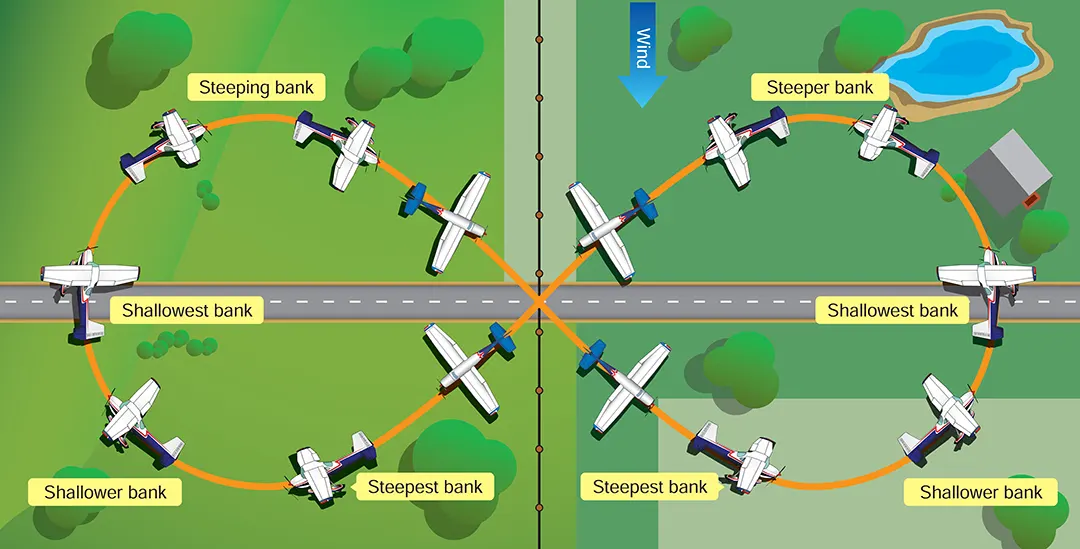
The loops should be flown across the road, with the wind perpendicular to the loops. Each time the reference is crossed, the crossing angle should be the same, and the airplane’s wings should be level.
The eights may also be performed by rolling immediately from one bank to the opposite bank directly over the reference.
Eights Around Pylons
Eights around pylons are a ground reference maneuver that uses the same principles and techniques for correcting wind drift as turns around a point, along with the same objectives as other ground track maneuvers.
This maneuver uses two ground reference points called pylons. Turns around each pylon are made in opposite directions to follow a figure-eight ground track. [Figure 3]
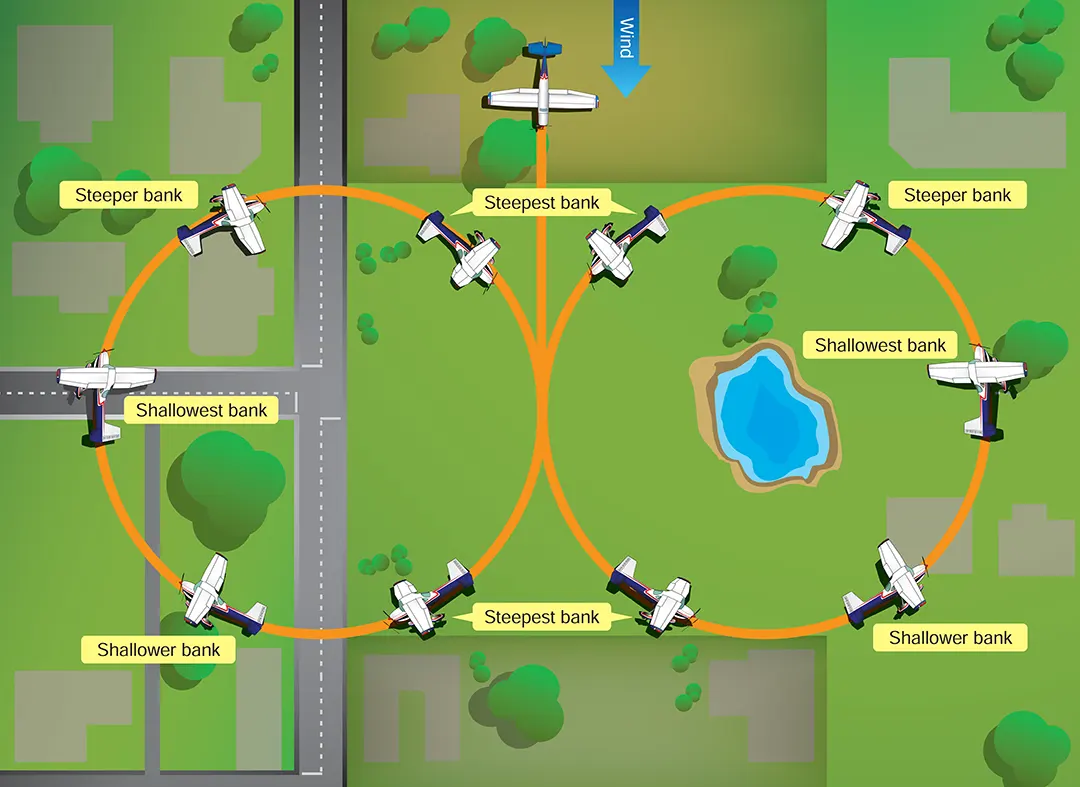
The pattern involves flying downwind between the pylons and upwind outside the pylons. It may include a short period of straight-and-level flight while proceeding diagonally from one pylon to the other.
The pylons should be positioned along a line perpendicular to the wind. The maneuver should be started with the airplane on a downwind heading while passing midway between the pylons.
The distance between the pylons and the wind velocity determine the initial bank angle required to maintain a constant turn radius around each pylon.
The steepest bank angles are necessary just after each turn entry and just before rollout from each turn, when the airplane is headed downwind and groundspeed is highest. The shallowest bank angles are required when the airplane is headed directly upwind and groundspeed is lowest.
As in other ground reference maneuvers, the rate at which the bank angle changes depends on wind velocity.
If the airplane proceeds diagonally from one turn to the other, the rollout from each turn must be completed on the proper heading with sufficient wind correction angle. This ensures that, after a brief period of straight-and-level flight, the airplane arrives at the point where a turn of the same radius can be made around the other pylon.
The straight-and-level flight segments should be tangent to both circular patterns.
Common Errors During Elementary Eights
Common errors in the performance of elementary eights include:
- Failure to adequately clear the surrounding area for safety hazards, initially and throughout the maneuver.
- Poor selection of ground references.
- Failure to establish a constant, level altitude before entering the maneuver.
- Failure to maintain adequate altitude control during the maneuver.
- Failure to properly assess wind direction.
- Failure to properly execute constant-radius turns.
- Failure to manipulate the flight controls in a smooth and continuous manner.
- Failure to establish the appropriate wind correction angles.
- Failure to apply coordinated aileron and rudder pressure, resulting in slips or skids.
- Failure to maintain orientation as the maneuver progresses.
Eights on Pylons
Eights on pylons are the most advanced and difficult of the ground reference maneuvers. Because of the techniques involved, eights on pylons are particularly effective for developing intuitive control of the airplane.
This maneuver is similar to eights around pylons, except that the airplane’s altitude is varied to maintain a specific visual reference to the pivot points.
Visual Reference Line and the Pylon
When performing eights on pylons, the pilot imagines a line parallel to the airplane’s lateral axis extending from the pilot’s eyes to the pylon. Along this line, the airplane appears to pivot as it turns around the pylon.
In other words, if a taut string extended from the pilot’s eyes to the pylon, the string would remain parallel to the airplane’s lateral axis as the airplane turns around the pylon.
The objective of eights on pylons is to keep this visual reference line parallel to the lateral axis. The line should not appear at an angle to the lateral axis while the airplane flies around the pylon. [Figure 4]
When explaining eights on pylons, instructors sometimes use the term “wingtip” to represent the proper visual reference line to the pylon. This interpretation is not correct.
High-wing, low-wing, swept-wing, and tapered-wing airplanes, as well as airplanes with tandem or side-by-side seating, all present different angles from the pilot’s eyes to the wingtip. [Figure 5]
The visual reference line is not necessarily located on the wingtip itself. It may be positioned ahead of, behind, above, or below the wingtip and differs for each pilot and each seating position in the airplane.
This is especially true in tandem (fore-and-aft) seat airplanes. In side-by-side airplanes, there is very little variation in the visual reference lines for different people if they are seated with their eyes at approximately the same level.
Therefore, when performing eights on pylons, as in other maneuvers requiring a lateral reference, the pilot should use a visual reference line that, from eye level, parallels the lateral axis of the airplane.
Pivotal Altitude and Groundspeed
The altitude appropriate for eights on pylons is called the pivotal altitude. It is determined by the airplane’s groundspeed.
In previous ground track maneuvers, the airplane flies a prescribed path over the ground, and the pilot attempts to maintain that track by correcting for wind. In eights on pylons, however, the pilot maintains lateral orientation to a specific spot on the ground.
This develops the pilot’s ability to maneuver the airplane accurately while dividing attention between the flightpath and the selected ground reference pylons.
A useful rule of thumb for estimating pivotal altitude is to square the groundspeed and then divide by 15 when groundspeed is expressed in miles per hour, or divide by 11.3 when groundspeed is expressed in knots. The mean sea level (MSL) elevation of the ground reference is then added.
The formulas are:
Groundspeed in miles per hour:
Groundspeed in knots:
Where:
- (PA) = Pivotal altitude (feet MSL)
- (GS) = Groundspeed (mph or knots, as applicable)
- (E) = Ground reference elevation (feet MSL)
The pivotal altitude is the altitude at which, for a given groundspeed, the projection of the visual reference line to the pylon appears to pivot.
Visually, a taut string extended from the pilot’s eyes to the pylon would remain parallel to the airplane’s lateral axis as the airplane turns around the pylon. [Figure 6]
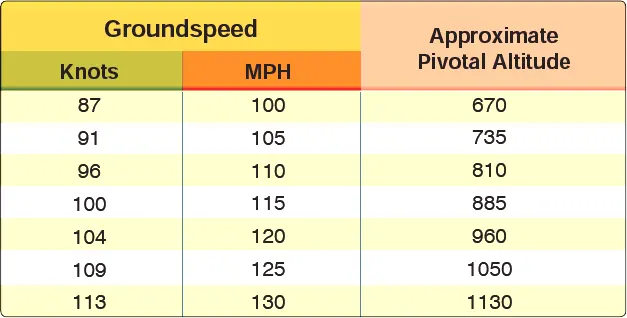
The pivotal altitude does not vary with the angle of bank unless the bank is sufficiently steep to affect groundspeed.
Effect of Altitude on the Visual Reference Line
Distance from the pylon affects the angle of bank.
At an altitude above the pivotal altitude, the projected reference line appears to move rearward in a circular path relative to the pylon. Conversely, when the airplane is below the pivotal altitude, the projected reference line appears to move forward in a circular path. [Figure 7]
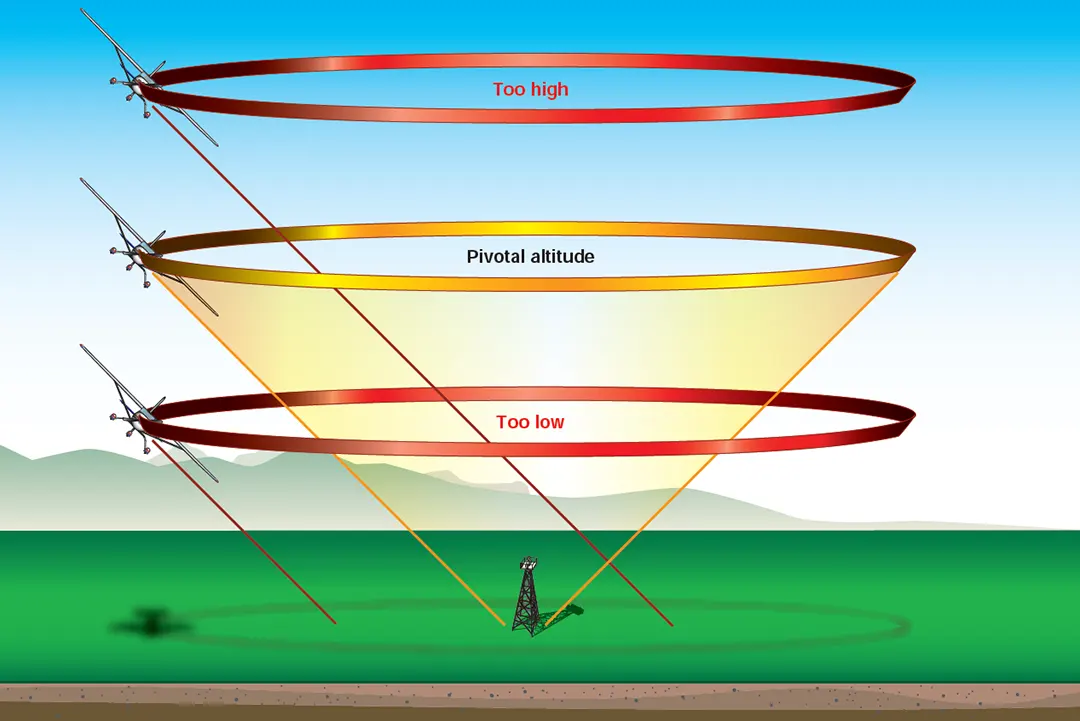
To demonstrate this, the pilot flies at maneuvering speed and at an altitude below the pivotal altitude, then places the airplane in a medium-banked turn. As the airplane turns, the projected visual reference line appears to move forward along the ground, and the pylon appears to move backward.
The pilot then climbs to an altitude well above the pivotal altitude. When the airplane is again at maneuvering speed, it is placed in a medium-banked turn. At the higher altitude, the projected visual reference line appears to move backward across the ground, and the pylon appears to move forward.
After demonstrating the maneuver at a high altitude, the pilot should reduce power and begin a descent at maneuvering speed while continuing the medium-banked turn around the pylon.
As altitude is lost, the apparent backward movement of the projected visual reference line relative to the pylon slows down and eventually stops momentarily. If the pilot continues the descent below the pivotal altitude, the projected visual reference line begins to move forward relative to the pylon.
The altitude at which the visual reference line ceases to move across the ground is the pivotal altitude.
If the airplane descends below the pivotal altitude, the pilot should increase power to maintain airspeed while regaining altitude until the projected reference line moves neither backward nor forward but instead appears to pivot on the pylon. In this way, the pilot can determine the pivotal altitude of the airplane.
Changes in Pivotal Altitude During the Maneuver
Pivotal altitude changes with variations in groundspeed.
Since the airplane’s heading continuously changes from downwind to upwind throughout the turns, groundspeed also changes. As a result, the appropriate pivotal altitude varies slightly throughout the turn.
The pilot should adjust for these changes by climbing or descending, as necessary, to keep the visual reference line aligned with the pylons.
Selecting Suitable Pylons
Selecting proper pylons is an important factor in successfully performing eights on pylons.
The pylons should be sufficiently prominent so the pilot can see them when completing the turn around one pylon and heading toward the next.
They should also be adequately spaced to provide time for planning the turns, but not so far apart that they result in unnecessary straight-and-level flight between the pylons.
The distance between the pylons should allow the straight-and-level flight segment to last approximately 3 to 5 seconds.
The selected pylons should also be at the same elevation, since differences of more than a few feet may necessitate climbing or descending between each turn.
The pilot should select two pylons along a line perpendicular to the direction of the wind.
Preflight Planning for Eights on Pylons
The pilot should estimate the pivotal altitude during preflight planning.
Weather reports and consultation with other pilots flying in the area may provide information about wind direction and velocity.
If the ground references are already known, the sectional chart can provide their MSL elevations. The Pilot’s Operating Handbook (POH) provides the range of maneuvering airspeeds based on aircraft weight. Wind direction and velocity can then be estimated to calculate the appropriate pivotal altitudes.
The pilot should calculate the pivotal altitude for each position: upwind, downwind, and crosswind.
Performing Eights on Pylons
The pilot should begin the maneuver by flying diagonally crosswind between the pylons to a point downwind of the first pylon, allowing the first turn to be made into the wind.
As the airplane approaches a position where the pylon appears to be just ahead of the wingtip, the pilot should begin the turn by lowering the upwind wing until the visual reference line aligns with the pylon.
The reference line should appear to pivot on the pylon.
As the airplane heads upwind, groundspeed decreases, which lowers the pivotal altitude. As a result, the pilot should descend to keep the visual reference line aligned with the pylon.
As the turn progresses on the upwind side of the pylon, the wind becomes more of a crosswind. Since this maneuver does not require the turn to be completed at a constant radius, the pilot does not need to apply drift correction to complete the turn.
If the visual reference line appears to move ahead of the pylon (the pylon appears to move backward), the pilot should increase altitude.
If the visual reference line appears to move behind the pylon (the pylon appears to move forward), the pilot should decrease altitude.
Deflecting the rudder to yaw the airplane and force the wing and reference line forward or backward toward the pylon places the airplane in uncoordinated flight at low altitude and with steep bank angles. This should not be attempted.
Transition Between Pylons
As the airplane turns toward a downwind heading, the pilot should roll out of the turn to allow the airplane to proceed diagonally to a point tangent to the downwind side of the second pylon.
The pilot should complete the rollout with the proper wind correction angle to compensate for wind drift. This ensures that, after reaching the second pylon, the airplane is at a point downwind from it and at an equal distance from the pylon as the corresponding starting point was from the first pylon.
At this point, the pilot should begin a turn in the opposite direction by lowering the upwind wing until the visual reference line aligns with the second pylon.
The pilot should then continue the turn using the same techniques as those used around the first pylon, but in the opposite direction.
Correcting the Visual Reference Line
With prompt corrections and very fine control pressures, it is possible to hold the visual reference line directly on the pylon, even in strong winds.
The pilot may correct temporary variations, such as those caused by gusts or inattention, by slightly reducing the bank angle to fly relatively straight and bring a lagging visual reference line forward, or by temporarily increasing the bank angle to turn back a visual reference line that has moved ahead.
With practice, these corrections may become slight enough to be barely noticeable.
It is important to understand that variations in pylon position are judged according to the apparent movement of the visual reference line. Attempting to correct pivotal altitude by using the altimeter is ineffective.
Bank Angle During Eights on Pylons
Eights on pylons are performed using bank angles ranging from shallow to steep. [Figure 8]
The pilot should understand that the bank angle selected does not alter the pivotal altitude for a given groundspeed.
As proficiency increases, the instructor should make the maneuver more challenging by directing the learner to enter at a distance from the pylon that results in a specific bank angle at the steepest point of the pylon turn.
Common Errors During Eights on Pylons
The most common error when attempting to hold a pylon is the incorrect use of the rudder.
When the projection of the visual reference line moves forward relative to the pylon, many pilots tend to apply inside rudder pressure to yaw the wing backward. When the reference line moves behind the pylon, pilots tend to apply outside rudder pressure to yaw the wing forward.
The pilot should use the rudder only for coordination.
Other common errors in the performance of eights on pylons include:
- Failure to adequately clear the surrounding area for safety hazards, initially and throughout the maneuver.
- Skidding or slipping in turns, whether attempting to hold the pylon with rudder or not.
- Excessive gain or loss of altitude.
- Poor choice of pylons.
- Failure to enter the pylon turns into the wind.
- Failure to establish a heading when flying between pylons that sufficiently compensates for drift.
- Failure to time the bank so that the turn entry is completed with the pylon in the correct position.
- Abrupt control usage.
- Inability to select the pivotal altitude.