
A principal ground reference maneuver is the rectangular course. [Figure 1] The rectangular course is a training maneuver in which the airplane maintains an equal distance from all sides of selected rectangular ground references.
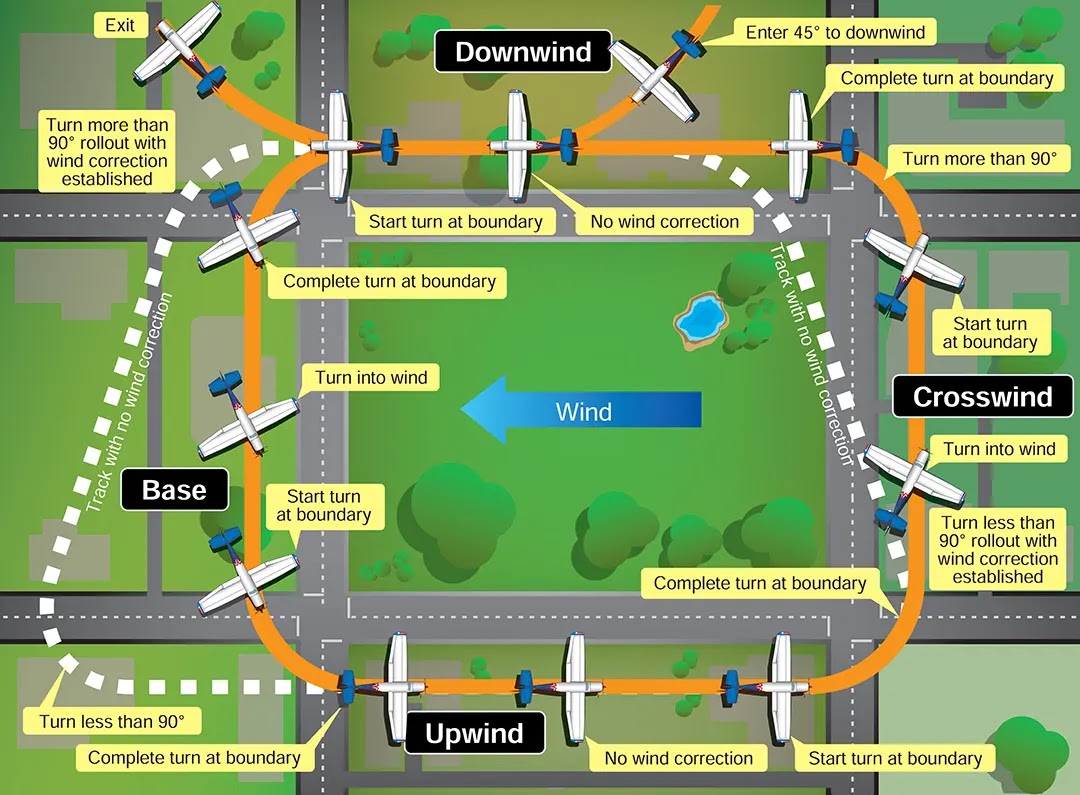
The maneuver is designed to replicate the airport traffic pattern that an airplane typically follows when preparing to land. While performing the rectangular course maneuver, the pilot should maintain a constant altitude, airspeed, and distance from the ground references.
The maneuver helps the pilot develop and practice the following skills:
- Maintaining a specific relationship between the airplane and the ground.
- Dividing attention between the flightpath, ground-based references, flight control inputs, outside hazards, and instrument indications.
- Adjusting the bank angle during turns to compensate for groundspeed changes and maintain constant-radius turns.
- Rolling out of turns with the required wind correction angle to compensate for wind drift.
- Establishing and correcting the wind correction angle to maintain the desired ground track.
- Preparing for airport traffic patterns and subsequent landing pattern practice.
Selecting the Rectangular Course Area
To fly the rectangular course, the pilot should first locate a square field, a rectangular field, or an area with suitable ground references on all four sides. Note that a square meets the definition of a rectangle.
As previously mentioned, the area should be selected in accordance with safe operating practices. The airplane should be flown parallel to the field boundaries or selected ground references, at an approximately equal distance of one-half to three-fourths of a mile away from them.
The flightpath should be positioned outside the field boundaries or selected ground references so that they can be easily observed from either pilot seat. It is not practical to fly directly above the field boundaries or selected ground references.
The pilot should avoid flying too close to the references because doing so requires very steep bank angles during turns. This increases the aerodynamic load factor and the airplane’s stall speed, particularly during the turn from the downwind leg to the crosswind leg.
Flying the Rectangular Course
The entry into the maneuver should be accomplished on the downwind leg. This places the wind behind the airplane and results in increased groundspeed. If the wind is directly behind the airplane, no wind correction angle is required; however, in actual flying conditions, some drift correction may be necessary.
Downwind to Base Leg
The turn from the downwind leg onto the base leg is entered with a relatively steep bank angle. The pilot should roll the airplane into a steep bank using rapid, but not excessive, coordinated aileron and rudder pressures.
As the airplane turns onto the following base leg, the tailwind component lessens and becomes a crosswind. The bank angle is gradually reduced using coordinated aileron and rudder pressures.
The pilot should anticipate lateral drift and compensate by turning more than 90°, angling toward the inside of the rectangular course.
Base Leg to Upwind Leg
The next turn is from the base leg to the upwind leg. Ideally, on the upwind leg, the wind is directly on the nose of the airplane, resulting in a direct headwind and decreased groundspeed. However, some drift correction may be necessary.
The pilot should roll the airplane into a medium-banked turn using coordinated aileron and rudder pressures. As the airplane turns onto the upwind leg, the crosswind component lessens and becomes a headwind. The bank angle is gradually reduced using coordinated aileron and rudder pressures.
Because the pilot was angled into the wind on the base leg, the turn to the upwind leg is less than 90°.
Upwind Leg to Crosswind Leg
The next turn is from the upwind leg to the crosswind leg. The pilot should slowly roll the airplane into a shallow-banked turn, as the developing crosswind tends to drift the airplane toward the inside of the rectangular course. The turn should be made using coordinated aileron and rudder pressures.
As the airplane turns onto the crosswind leg, the headwind component lessens and becomes a crosswind. As the turn nears completion, the bank angle is reduced using coordinated aileron and rudder pressures.
To compensate for the crosswind, the pilot maintains an angle into the wind, toward the outside of the rectangular course. This requires a turn of less than 90°.
Crosswind Leg to Downwind Leg
The final turn returns the airplane to the downwind leg. This turn requires a medium bank angle and a turn greater than 90°.
The groundspeed increases as the turn progresses. The bank angle should be maintained and then reduced during rollout using rapid, but not excessive, coordinated aileron and rudder pressures.
Maintaining the Rectangular Ground Track
For the maneuver to be executed properly, the pilot should use ground-based, nose, and wingtip references to position the airplane correctly in attitude and orientation relative to the rectangular course.
To maintain a constant ground-based radius during the turns, the pilot must adjust the bank angle to compensate for changes in groundspeed. The higher the groundspeed, the steeper the bank angle required.
If the groundspeed is initially high and then decreases throughout the turn, the bank angle should progressively decrease. Conversely, if the groundspeed is initially slow and then increases throughout the turn, the bank angle should progressively increase until rollout begins.
The rate of rolling into and out of the turns should also be adjusted to prevent the airplane from drifting toward the inside or outside of the course.
When the wind is from a direction that could drift the airplane toward the inside of the course, the banking roll-in rate should be slow. When the wind is from a direction that could drift the airplane toward the outside of the course, the banking roll-in rate should be quick.
Common Errors During Rectangular Course Maneuvers
The following are the most common errors made while performing rectangular course maneuvers:
- Failure to adequately clear the surrounding area for safety hazards, initially and throughout the maneuver.
- Failure to establish a constant, level altitude before entering the maneuver.
- Failure to maintain altitude during the maneuver.
- Failure to properly assess wind direction.
- Failure to establish the appropriate wind correction angle.
- Failure to apply coordinated aileron and rudder pressure, resulting in slips and skids.
- Failure to manipulate the flight controls in a smooth and continuous manner.
- Failure to properly divide attention between airplane control and orientation with ground references.
- Failure to execute turns with accurate timing.