
Pilots must be able to recognize and prevent airplane upsets to maintain aircraft control and reduce the risk of loss of control in flight (LOC-I). Understanding the environmental, mechanical, and human factors that contribute to upsets helps pilots recognize developing hazards, take appropriate preventive action, and recover safely when an upset occurs. Upset prevention and recovery training (UPRT) develops the knowledge and skills needed to recognize unusual flight conditions, maintain aircraft control, and respond appropriately to unexpected events.
Table of Contents
Table of Contents
Upset Prevention and Recovery
An unusual attitude is commonly described as an unintended or unexpected aircraft attitude encountered during instrument flight. Unusual attitudes are introduced during student pilot training as part of basic attitude instrument flying. They continue to be practiced and evaluated during training for an instrument rating, aircraft type rating, and airline transport pilot certificate.
Pilots learn about the conditions and situations that can cause unusual attitudes, with an emphasis on recognizing and recovering from them.
Unusual Attitudes Versus Upsets
Based on the definition of an upset, there are several key distinctions between an unusual attitude and an upset. An upset:
- Includes stall events.
- Includes overspeeds or other inappropriate airspeeds for a given flight condition.
- Has defined parameters. For example, during training, an instructor might place an airplane in a 30° bank with a nose-up pitch attitude of 15° and ask the student to recover. This would be considered an unusual attitude but would not meet the defined attitude parameters for an upset.
- Involves unintentional situations that may produce a startle response. During conventional unusual-attitude training, for example, the pilot is often instructed to close their eyes before the instructor changes the airplane’s attitude. Because the pilot expects the exercise, the element of surprise is reduced.
The four leading causal and contributing factors associated with upsets that result in LOC-I accidents are:
- Environmental factors
- Mechanical factors
- Human factors
- Stall-related factors
Environmental Factors
Turbulence, which can result from large variations in wind velocity over a short distance, can cause an upset and lead to LOC-I. Pilots should remain aware of conditions that can produce different types of turbulence, including clear-air turbulence, mountain waves, wind shear, thunderstorms, and microbursts.
In addition to turbulence caused by environmental conditions, wake turbulence from other aircraft can also lead to an upset and LOC-I.
Icing can disrupt the smooth airflow over an airfoil, increase drag, and reduce the airfoil’s ability to produce lift. It can therefore significantly degrade airplane performance and may result in a stall if the condition is not managed correctly.
Mechanical Factors
Modern airplanes and their equipment are generally reliable, but mechanical anomalies can occur. Some mechanical failures can directly cause a departure from normal flight, including asymmetrical flap operation, malfunctioning or binding flight controls, and runaway trim.
Upsets can also occur because of a malfunction or misuse of the autoflight system. Advanced automation may mask the cause of an anomaly. Disengaging the autopilot and autothrottles, when appropriate, allows the pilot to control the airplane directly and may help eliminate the cause of the problem.
For these reasons, pilots should maintain proficiency in manually flying the airplane under the applicable flight conditions without relying on the autopilot or autothrottles.
Although these and other in-flight anomalies may not always be preventable, knowledge of aircraft systems and the procedures recommended in the aircraft flight manual or pilot’s operating handbook (AFM/POH) can help pilots minimize their effects and prevent an upset.
In the event of instrument failures, avoiding an upset and subsequent LOC-I may depend on the pilot’s proficiency in using secondary instrumentation and performing partial-panel operations.
Human Factors
VMC to IMC
Accident reports indicate that continuing visual flight rules (VFR) flight from visual meteorological conditions (VMC) into marginal VMC or instrument meteorological conditions (IMC) is a contributing factor in LOC-I accidents.
Losing the natural horizon substantially increases the risk of vertigo and spatial disorientation, which can lead to an upset.
IMC
When operating in IMC, pilots must maintain proficiency in instrument flying and carefully cross-check available flight instruments to determine the airplane’s attitude and flightpath. Relying on bodily sensations rather than reliable instrument indications can lead to spatial disorientation and loss of aircraft control.
Pilots should also recognize when weather conditions, workload, or their level of proficiency exceed their capabilities and take appropriate action to avoid an unsafe situation.
Diversion of Attention
In addition to its direct effects, an in-flight anomaly or malfunction can lead to an upset if it diverts the pilot’s attention from basic aircraft control responsibilities.
Failing to monitor automated systems, over-relying on automation, or having incomplete knowledge of or experience with those systems can contribute to an upset. Diversion of attention can also occur when a pilot attempts to set avionics or navigation equipment while flying the airplane.
Task Saturation
The margin of safety is the difference between task requirements and a pilot’s capabilities. An upset and eventual LOC-I can occur when task requirements exceed those capabilities.
For example, recovering an airplane from a near-inverted attitude to an upright orientation may require skills beyond those learned during primary flight training.
In another example, a fatigued pilot who inadvertently encounters IMC at night while experiencing a vacuum pump failure may become disoriented. Similarly, a pilot who fails to engage pitot heat while flying in IMC may lose control because of the demands of extended and unfamiliar partial-panel flight.
Unnecessary low-altitude flying and impromptu demonstrations for friends or people on the ground can also cause pilots to exceed their capabilities, with potentially fatal consequences.
Sensory Overload/Deprivation
During an upset, a pilot’s ability to interpret warnings, annunciations, instrument indications, and other aircraft cues may be limited. Pilots may be confronted with multiple visual, auditory, and tactile warnings occurring simultaneously or in rapid succession.
Conversely, expected warnings may not occur when they should. The absence of an expected warning can be as distracting as receiving multiple warnings.
Separating time-critical information from distractions requires practice, experience, and knowledge of the airplane and its systems. Cross-checks are necessary not only to confirm information from other sources but also to determine whether information is missing or invalid.
For example, a stall warning system may fail to alert a pilot that the airplane is approaching a stall. The pilot must therefore recognize other cues that may indicate an impending stall and take appropriate action to prevent a stall and possible LOC-I. These cues can include aerodynamic buffet, loss of roll authority, or an inability to arrest a descent.
Spatial Disorientation
Spatial disorientation has been a significant factor in many airplane upset accidents. Accident data from 2008 to 2013 identified nearly 200 accidents associated with spatial disorientation, more than 70 percent of which were fatal.
All pilots are susceptible to false sensory illusions when flying at night or in certain weather conditions. These illusions can create a conflict between the airplane’s actual attitude, as indicated by reliable flight instruments, and the attitude the pilot senses.
Disoriented pilots may not realize that their perception of the airplane’s orientation is incorrect. Many airplane upsets occur while pilots are performing tasks that divert their attention from flight instruments or outside references. Other pilots perceive a conflict between bodily sensations and instrument indications but allow the airplane to deviate from its intended flightpath because they cannot resolve the conflict.
A pilot may experience spatial disorientation in one of three ways:
- Recognized spatial disorientation: The pilot recognizes the developing upset or existing upset condition and is able to correct the situation safely.
- Unrecognized spatial disorientation: The pilot is unaware that an upset is developing or has occurred and fails to make essential decisions or take corrective action to prevent LOC-I.
- Incapacitating spatial disorientation: The pilot is unable to recover because of a combination of factors, such as not understanding the unfolding events, lacking the skills needed to correct the situation, or exceeding the psychological or physiological ability to cope with the situation.
For more information about the causes of spatial disorientation, refer to the FAA’s Spatial Disorientation and Aerospace Medicine Reference Collection, which includes educational videos on spatial disorientation.
Surprise and Startle Response
Surprise is a response to an unexpected event that violates a pilot’s expectations and can affect the mental processes used to respond to the event.
Startle is an automatic, involuntary physiological response to a sudden, intense event that violates expectations. It can involve an immediate muscle reflex and increases in heart rate and blood pressure.
These responses to unexpected events have traditionally been underestimated or overlooked during flight training. In reality, pilots without adequate preparation may experience surprise or a startle response during an airplane upset. Startle may occur with or without a subsequent feeling of surprise.
Pilots can prepare for these reactions through scenario-based training. Instructors can incorporate realistic distractions and unexpected events to help pilots experience and manage startle and surprise.
For such training to be effective, controlled scenarios should create a realistic perception of risk or potential consequences sufficient to increase the pilot’s stress level. These scenarios can help pilots prepare to manage the psychological and physiological reactions that may occur during an actual upset.
Upset Prevention and Recovery Training (UPRT)
Upsets are generally unintentional events, except when deliberately introduced during training, and are therefore often unexpected. An inexperienced or inadequately trained pilot may react instinctively rather than deliberately when confronted with an unexpected abnormal flight attitude.
Such a pilot may respond with abrupt control inputs that are ineffective or hazardous, particularly in turbulent conditions, at excessive airspeeds, or at low altitudes.
Without appropriate training in upset recognition, interpretation, and aircraft control, a pilot can quickly aggravate an abnormal flight attitude into a potentially fatal LOC-I accident. UPRT therefore focuses on preventing upsets and recovering from them if they occur. [Figure 1]

- Upset prevention: Refers to pilot actions taken to avoid a deviation from the desired airplane state. Awareness and prevention training help pilots avoid hazardous situations. Early recognition of a developing upset, combined with appropriate preventive action, can often mitigate a situation that might otherwise escalate into an LOC-I accident.
- Recovery: Refers to pilot actions that return an airplane whose altitude, airspeed, or attitude is diverging from the desired state to a desired flight condition after an upset begins or becomes fully developed. Recovery training helps reduce accidents resulting from unavoidable or inadvertently encountered upsets. Pilots learn to initiate recovery toward a normal flight condition as soon as a developing upset is recognized.
Control inputs and power adjustments used to counter an upset should be proportional to the magnitude and rate of change of roll, yaw, pitch, and airspeed. This helps avoid overstressing the airplane, except when immediate action is necessary to avoid ground contact.
UPRT Training Core Concepts
Airplane upsets are time-critical events that can place pilots in unusual and unfamiliar attitudes, sometimes requiring control inputs that seem counterintuitive. An upset can create a life-threatening situation made worse by panic, reduced mental capacity, and potentially incapacitating spatial disorientation.
Real-world upsets often leave very little time to react. Exposure to appropriate scenarios during training can reduce surprise and confusion during an unexpected event. The goal is to help pilots recognize an escalating threat or sensory overload promptly and identify and correct a developing upset.
UPRT emphasizes recognizing when an airplane begins to deviate from its intended flightpath or airspeed. Pilots must identify the developing condition and determine what action, if any, is necessary.
As a general principle, when visual cues or instrument indications differ from what is expected during a basic flight maneuver, pilots should promptly cross-check the airplane’s attitude and determine whether an upset, instrument error, or instrument malfunction may be involved.
For maximum effectiveness, UPRT concepts must be taught accurately and in a non-threatening manner. Positive training experiences can improve understanding, retention of skills, and motivation for continued training.
A carefully structured training environment allows pilots to experience relevant situations and can help them respond more quickly, decisively, and calmly when unexpected events occur during flight. However, upset prevention and recovery skills can deteriorate over time and require continued reinforcement through training.
UPRT conducted in an airplane or flight simulation training device (FSTD) should include both visual and simulated instrument conditions. This allows pilots to practice recognition and recovery in both situations and experience some of the physiological effects associated with an upset, including confusion and disorientation caused by misleading visual cues.
Training that includes recovery from bank angles exceeding 90° may further develop upset recognition and recovery skills. Such training requires appropriate measures to ensure that the airplane or FSTD is suitable and that instructors are properly qualified.
Upset prevention and recovery training differs from aerobatic training. [Figure 2] During aerobatic training, pilots know and expect the maneuvers, so the effects of surprise and startle are reduced. The primary goal of aerobatic training is to teach pilots to maneuver an aerobatic-capable airplane intentionally and precisely in three dimensions.
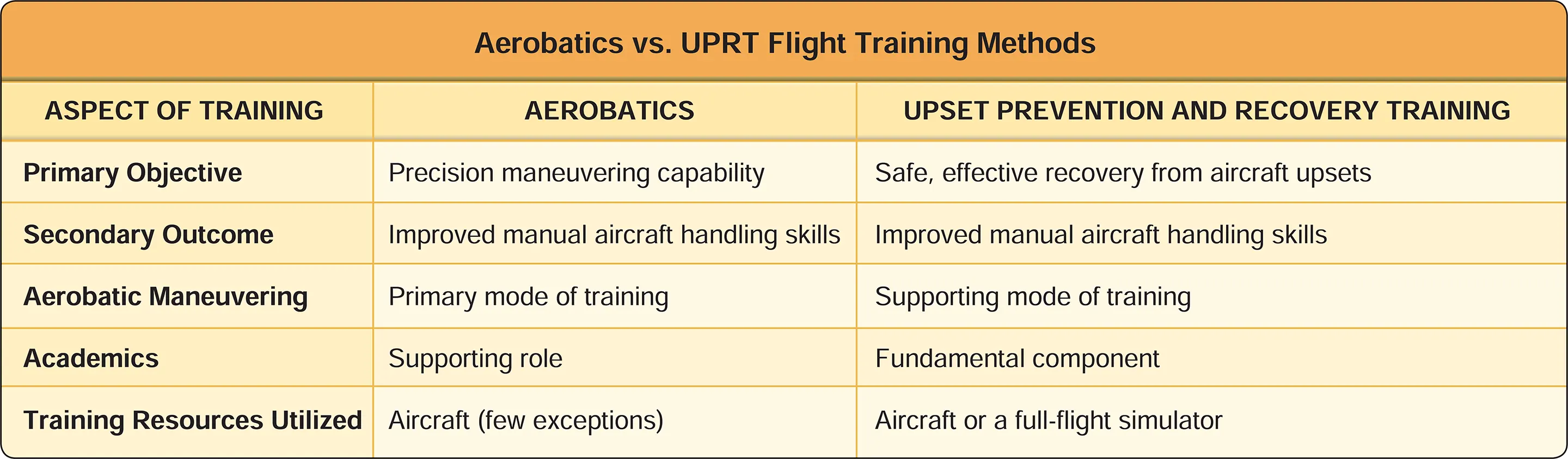
The primary goal of UPRT is to help pilots manage sudden stress and avoid, prevent, and recover from unplanned deviations that could lead to LOC-I.
Comprehensive UPRT includes three mutually supportive components: academic training, airplane-based training, and, typically at the transport-category type-rating training level, FSTD-based training. Each component has unique benefits and limitations. When integrated throughout a pilot’s career, these components can provide comprehensive preparation for upset awareness, prevention, recognition, and recovery.
Academic Material (Knowledge and Risk Management)
Academic training establishes the foundation for developing situational awareness, insight, knowledge, and skills. As with practical skill development, academic preparation should progress from general concepts to specific applications while emphasizing the significance of each basic principle.
Although academic preparation is crucial and can help mitigate LOC-I risks, long-term knowledge retention is best achieved when classroom learning is applied and reinforced through practical experience.
The academic portion of UPRT should also address aeronautical decision-making (ADM), risk management (RM), and proportional counter-response as part of upset prevention.
Prevention Through ADM and Risk Management
This element of prevention typically occurs over minutes or hours. It involves effective ADM and risk management through analysis, awareness, resource management, basic airmanship, sound judgment, and interruption of the error chain.
For example, a pilot may assess conditions at an airport before descent and recognize that they are too severe for a safe landing. Using situational awareness to avoid a potentially hazardous flight condition is an example of preventing an LOC-I situation through effective risk management.
Pilots should evaluate the circumstances of each flight, including the aircraft, equipment, and environment, and identify situations that may require a higher level of risk management. These may include low-altitude maneuvering, steep turns in the traffic pattern, uncoordinated flight, and increased load factors.
Another component of ADM is crew resource management (CRM) or single-pilot resource management (SRM). Both are relevant to UPRT.
When available, a coordinated crew response to potential or developing upsets can improve situational awareness, provide mutual support, and increase the margin of safety. Because an untrained crewmember can introduce uncertainty during an upset, individual UPRT skills should be established before training is integrated into a multi-crew CRM environment.
A crew should be able to:
- Communicate and confirm the situation clearly and concisely.
- Transfer control to the crewmember with the best situational awareness.
- Use standardized interactions to work as a team, improve awareness, manage stress, and mitigate fear.
Prevention Through Proportional Counter-Response
Proportional counter-response is the timely use of flight controls and thrust, by an individual pilot or crew as appropriate, to manage an unintended or uncommanded deviation in airplane attitude or flight envelope.
This element of prevention typically occurs over seconds or fractions of a second. The goal is to recognize a developing upset and take proportionate corrective action before the airplane enters a fully developed upset.
Because a developing upset may occur suddenly and unexpectedly, there is a risk that a pilot may panic or overreact, potentially aggravating the situation. Appropriate training helps pilots recognize the deviation and respond with suitable control inputs.
Recovery
The academic portion of UPRT establishes the knowledge, procedures, and techniques needed for safe recovery. Airplane-based and FSTD-based training then translate this knowledge into structured practice.
Training may begin with classroom visualization of recovery procedures, continue with repeated practice in an airplane, and then be further developed in a suitable simulated environment.
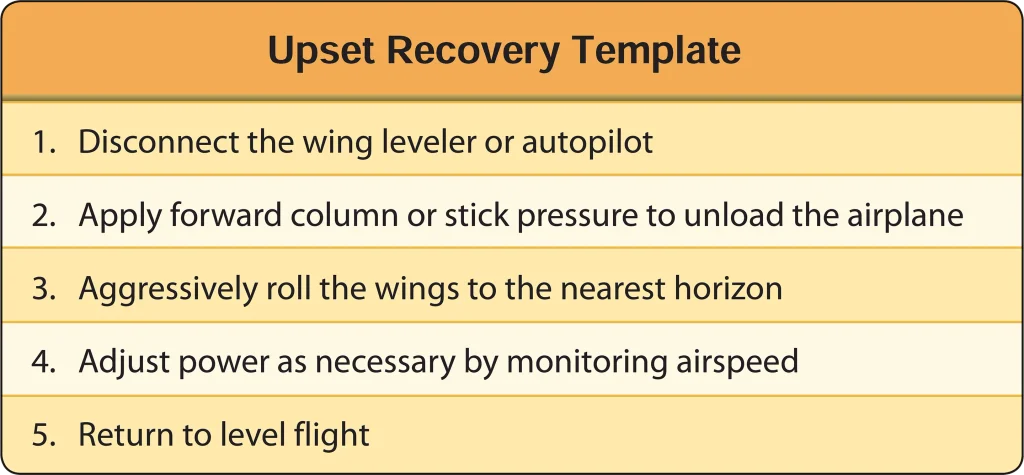
If looking outside does not provide sufficient awareness of the airplane’s attitude, pilots can use flight instruments to recognize and recover from an upset. For nose-high and nose-low attitudes, pilots should follow the procedures recommended in the applicable AFM/POH. General upset recovery procedures are summarized in Figure 3.
Common Errors
Common errors associated with upset recovery include:
- Incorrectly assessing the type of upset.
- Failing to disconnect the wing leveler or autopilot when required.
- Failing to unload the airplane, if necessary.
- Rolling in the wrong direction.
- Managing airspeed inappropriately during recovery.
Roles of FSTDs and Airplanes in UPRT
Training devices range from aviation training devices (including basic and advanced devices) to flight simulation training devices (FSTDs), such as flight training devices (FTDs) and full flight simulators (FFSs). These devices have different capabilities and limitations compared with actual flight.
The FAA handbook identifies higher-fidelity Level C and D full flight simulators as suitable substitutes for certain aspects of developing UPRT skills in an actual aircraft. Other training devices have more limited capabilities, so initial skill development may need to take place in a suitable airplane, with an appropriate training device used to reinforce and develop those skills. [Figure 4]

Airplane-Based UPRT
The more realistic the training scenario, the more memorable the learning experience can be. Although a modern simulator may be capable of presenting a visual scene showing a 110° bank with the nose 30° below the horizon, experiencing that scene in a simulator may not provide the same learning experience as encountering the attitude in an airplane under properly controlled training conditions.
Experiencing upsets in flight in a controlled training environment can enhance learning and help pilots manage fear during an airplane upset.
However, airplane-based UPRT has limitations. The extent of upset training that can be conducted depends on the maneuvers approved for the particular airplane and the instructor’s UPRT capabilities.
For example, UPRT conducted in a normal-category airplane by a typical flight instructor will necessarily differ from training conducted in an aerobatic-category airplane by an instructor with aerobatic expertise.
When upset training is conducted in an aerobatic-capable airplane, the importance of employing instructors with specialized UPRT experience cannot be overemphasized. Just as instrument or tailwheel instruction requires specific skills, UPRT requires instructors who can oversee trainee progress and intervene when necessary, consistently and professionally.
As in any area of flight training, improperly delivered stall, spin, and upset recovery training can result in negative learning. This can have serious consequences both during training and later, when pilots carry passengers and are responsible for the safety of others.
All-Attitude/All-Envelope Flight Training Methods
Sound UPRT covers a wide range of possible flight attitudes and the airplane’s operating flight envelope within the limits appropriate for the training. This training helps prepare pilots for unexpected upsets.
As noted earlier, the primary focus of a comprehensive UPRT program is to avoid upsets and recover safely when they occur. Many of the skills and techniques required for upset recovery are transferable between airplanes, although specific procedures and operating limitations remain aircraft-dependent.
Just as basic instrument skills learned in lighter, lower-performance airplanes can be applied to more advanced airplanes, fundamental upset recovery skills can benefit pilots throughout their flying careers.
FSTD-Based UPRT
UPRT can be effective in high-fidelity devices, such as Level C and D full flight simulators. However, instructors and pilots should be aware of the technical and physiological limitations of the particular FSTD used for upset training.
The FAA handbook identifies UPRT as a training requirement for pilots seeking a multiengine airplane airline transport pilot (ATP) certificate under 14 CFR § 61.156. The training course must be FAA-approved.
Coordinated Flight
Coordinated flight requires the pilot to account for yaw effects associated with power and propeller forces, aileron inputs, turning, and airplane rigging.
An airplane is generally in coordinated flight when its nose is aligned with the relative wind and the ball is centered in the slip/skid indicator. There are exceptions to this indication, including certain multiengine operations following an engine failure. [Figure 5]
Angle of Attack
The angle of attack (AOA) is the angle between the wing’s chord line and the relative wind. The chord line is an imaginary straight line extending from the wing’s leading edge to its trailing edge.
At low angles of attack, airflow over the upper surface of the wing generally remains smooth, producing lift with a relatively small amount of drag. As AOA increases, lift and drag generally increase. However, when the wing exceeds its critical AOA, airflow separates from the upper surface, reducing lift and increasing drag. This condition is known as a stall and can lead to loss of control if AOA is not reduced.
It is important for pilots to understand that a stall results from exceeding the critical AOA, not simply from insufficient airspeed. The term “stalling speed” can be misleading because this speed is commonly discussed for a particular airplane weight and configuration under an assumed 1G flight condition.
Increased load factor directly affects stall speed. Other factors, including gross weight, center of gravity, and flap setting, can also affect stall characteristics and stall speed.
Therefore, a wing can stall at a wide range of airspeeds, flight attitudes, and power settings whenever its critical AOA is exceeded.
For example, if a pilot maintains airspeed and establishes a coordinated, level turn at a 60° bank angle, the load factor is approximately 2G. Under the corresponding conditions, the stall speed is approximately 41 percent higher than the 1G stall speed.
In that 2G level turn, the pilot must increase AOA to produce the additional lift needed to maintain altitude. The wing is consequently closer to its critical AOA than it is during 1G level flight, and the airplane reaches the stall at a higher airspeed.
Because stall speed is not a single constant value under all conditions, pilots must understand the factors that affect it to maintain aircraft control in different flight situations.