
Weather conditions at departure can significantly affect an instrument flight, particularly when visibility is reduced or obstacles must be avoided during the initial climb. Pilots must understand takeoff minimums, applicable operating rules, weather reports, and runway visual range (RVR) to make informed departure decisions. This section explains the departure-weather requirements and visibility information used in IFR operations.
Takeoff Minimums
A mechanical failure can be hazardous during any phase of flight, but a failure during takeoff in instrument meteorological conditions (IMC) can be especially critical. In an emergency, the pilot must decide whether to return to the departure airport or proceed directly to a takeoff alternate. If the weather at the departure airport is below the applicable landing minimums, returning may not be an option, leaving the pilot with limited choices and little time to reach a takeoff alternate.
In the early years of air transportation, takeoff minimums for commercial operators were often higher than landing minimums. This meant that weather conditions could permit an aircraft to land at an airport but not depart from it. Takeoff minimums also historically included both ceiling and visibility requirements. Today, takeoff minimums are generally lower than published landing minimums, and ceiling requirements are included when necessary to ensure obstacle avoidance in the departure area.
The FAA publishes takeoff minimums for airports with instrument approach procedures. These minimums are primarily applicable to operators under 14 CFR Parts 121 and 135. When takeoff minimums are not published for an airport, standard civil takeoff minimums generally apply to operators subject to 14 CFR § 91.175(f): 1 statute mile (SM) for aircraft with two engines or fewer, and ½ SM for aircraft with more than two engines and for helicopters.
Aircraft operating under 14 CFR Part 91 are generally not subject to the civil takeoff visibility minimums that apply to Parts 121, 125, 129, and 135 under § 91.175(f). A zero-zero departure may be legally possible in some circumstances, but it is not advisable. Part 91 pilots must still comply with applicable obstacle-clearance requirements and departure procedures. Commercial operators must comply with applicable takeoff minimums, so instrument pilots should use sound judgment and consider the published minimums when planning departures.
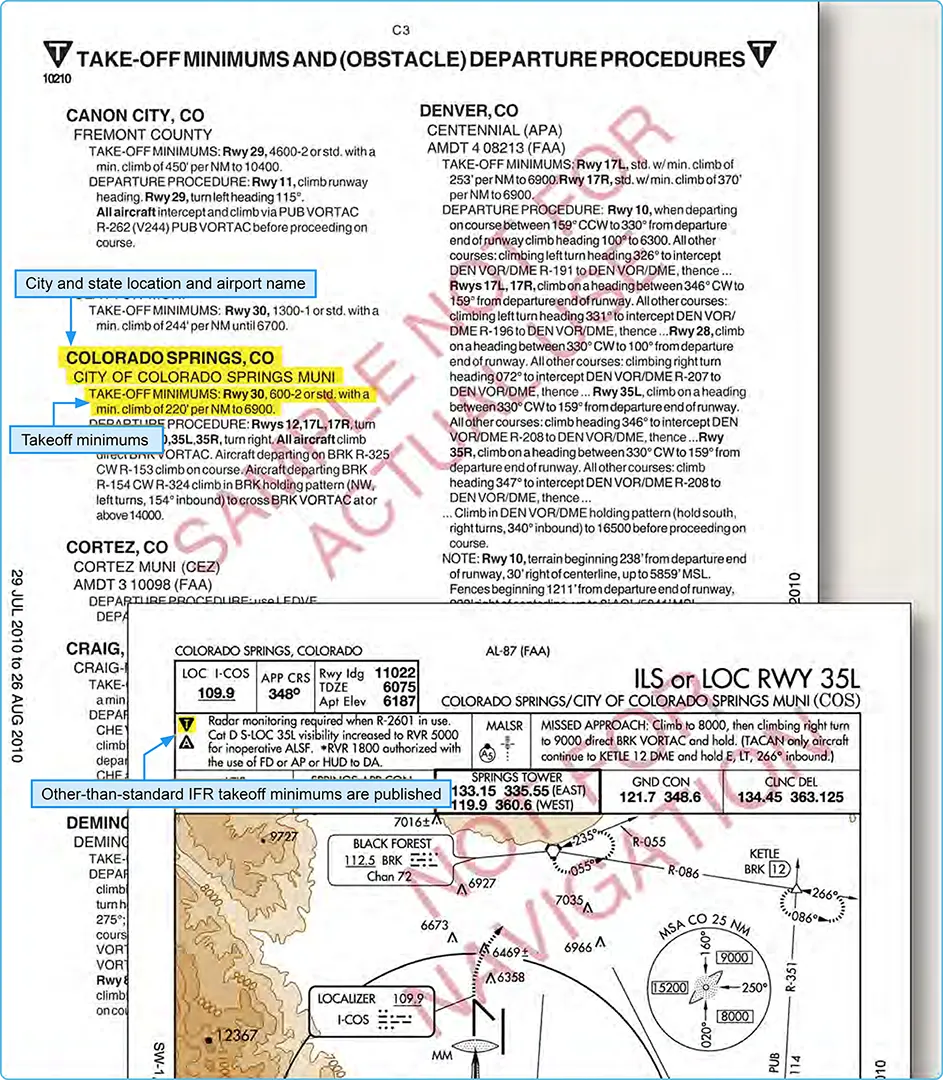
FAA Aeronautical Information Services publications list takeoff minimums for runways at airports with nonstandard minimums. These minimums are listed alphabetically by airport near the front of the Terminal Procedures Publication (TPP). An airport with nonstandard takeoff minimums is identified by a “T” symbol (sometimes called the “Triangle T” or “Trouble T”) in the notes section of the instrument procedure chart. Takeoff minimums are listed before the obstacle departure procedure (ODP) in the TPP. Some departure procedures permit departures using standard minimums if specified aircraft performance requirements are met. [Figure 1]
Takeoff Minimums for Commercial Operators
Part 121 and Part 135 operators are the primary users of published takeoff minimums. However, they may be authorized to use alternative minimums through their individual Operations Specifications (OpSpecs). These authorizations may permit departures with lower-than-standard minimums when the required aircraft equipment, airport facilities, and crew training are in place.
Operations Specifications (OpSpecs)
The air transportation industry must establish and administer safety standards that accommodate many variables. These include different aircraft types, operator capabilities, types of air transportation, and continual changes in aviation technology. It is impractical to address every situation and variation in operator capability through individual regulations or to continually revise regulations for rapidly changing technology.
Regulations therefore generally establish broad safety standards that allow different acceptable methods of compliance. OpSpecs provide a practical way to establish standards for a wide range of variables. They can be adapted to a certificate holder’s aircraft class and size, as well as the type and kinds of operations, and tailored to the operator’s specific needs.
Part 121 and Part 135 certificate holders may use approved OpSpecs to authorize lower-than-standard takeoff minimums. Depending on the aircraft equipment, crew training, and equipment installed at the airport, an operator may be authorized to depart from suitably equipped runways with minimums as low as 300 feet RVR. This is not a universal minimum; it applies only when specifically authorized. OpSpecs also address approach minimums, alternate airports, and weather services. The source refers to Volume 3 of FAA Order 8900.1, Flight Standards Information Management System (FSIMS).
Ceiling and Visibility Requirements
Takeoffs and departures have visibility minimums, and some procedures may also specify ceiling requirements. Visibility is reported in several ways and distributed through different sources, including automated weather observations. Before departure, flight crews should review current weather, including ceiling and visibility.
For IFR departures, pilots should obtain current visibility information immediately before departure. When both ceiling and visibility minimums are specified for an IFR departure, both requirements apply.
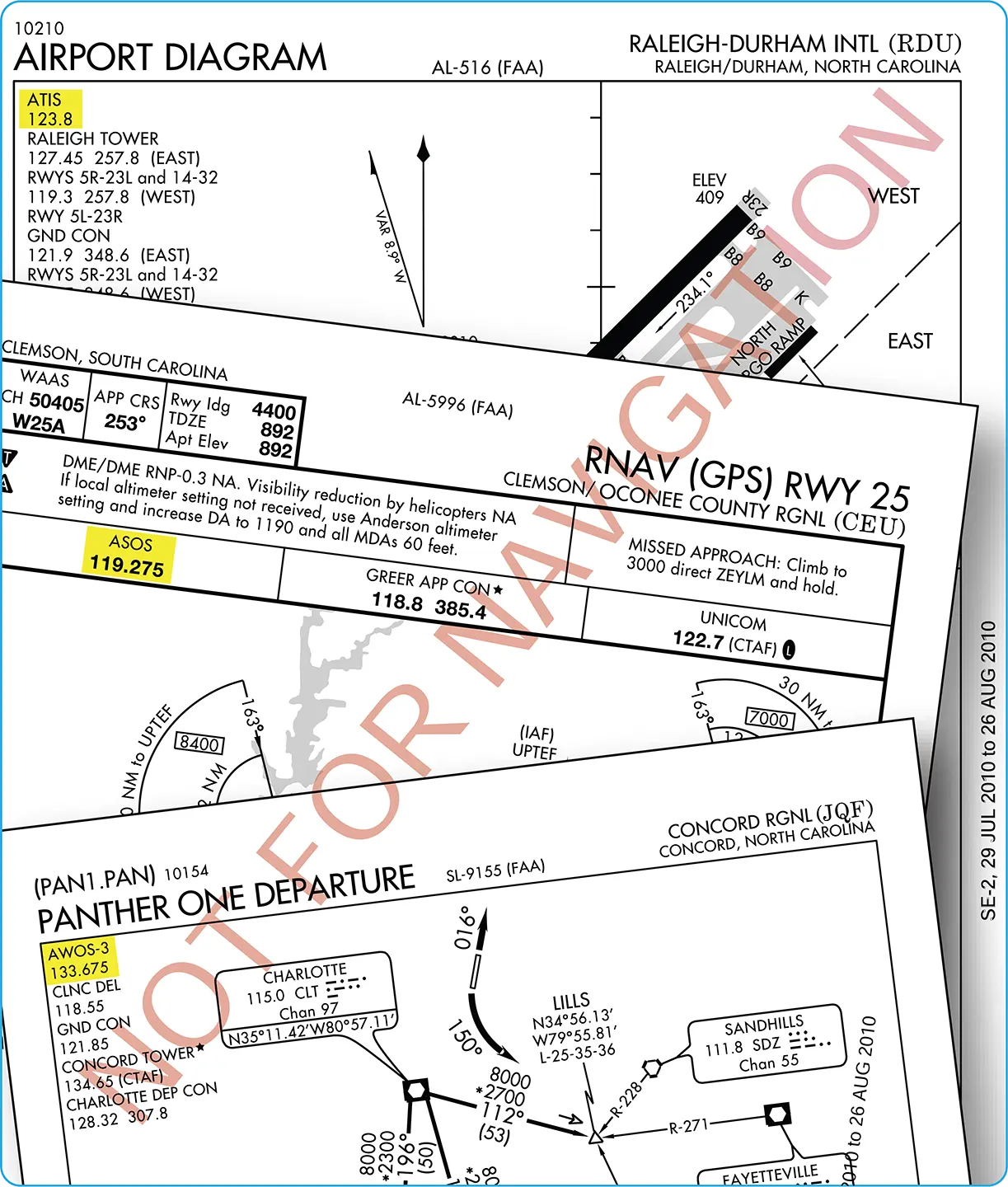
Weather reporting stations and weather sources for airports can be identified in the Chart Supplement (CS). The CS lists weather sources, their telephone numbers, and frequencies by airport. Weather frequencies and services—such as Automatic Terminal Information Service (ATIS), Digital ATIS (D-ATIS), Automated Weather Observing System (AWOS), Automated Surface Observing System (ASOS), and Flight Service Station (FSS)—may also be published on approach charts. [Figure 2]
Visibility
Visibility is the ability, determined by atmospheric conditions and expressed as a distance, to see and identify prominent unlighted objects during the day and prominent lighted objects at night. Visibility may be reported in statute miles, hundreds of feet, or meters.
Prevailing Visibility
Prevailing visibility is the greatest horizontal visibility that is equaled or exceeded throughout at least half of the horizon circle. The area does not need to be continuous. Prevailing visibility is reported in statute miles or fractions of a mile.
Runway Visibility Value (RVV)
Runway visibility value (RVV) is the visibility measured for a particular runway by a transmissometer. The instrument provides a continuous indication of runway visibility, reported in statute miles or fractions of a mile. RVV may be used in lieu of prevailing visibility when determining minimums for a particular runway.
Tower Visibility
Tower visibility is the prevailing visibility determined from the airport traffic control tower at locations where tower visibility and surface visibility are both reported.
Runway Visual Range (RVR)
Runway visual range (RVR) is an instrument-derived value, based on standard calibrations, that represents the horizontal distance a pilot can expect to see along the runway from the approach end. It is based on the visibility of high-intensity runway lights or the visual contrast of other targets, whichever provides the greater visual range. RVR represents horizontal visual range, not slant visual range, and is reported in hundreds of feet.
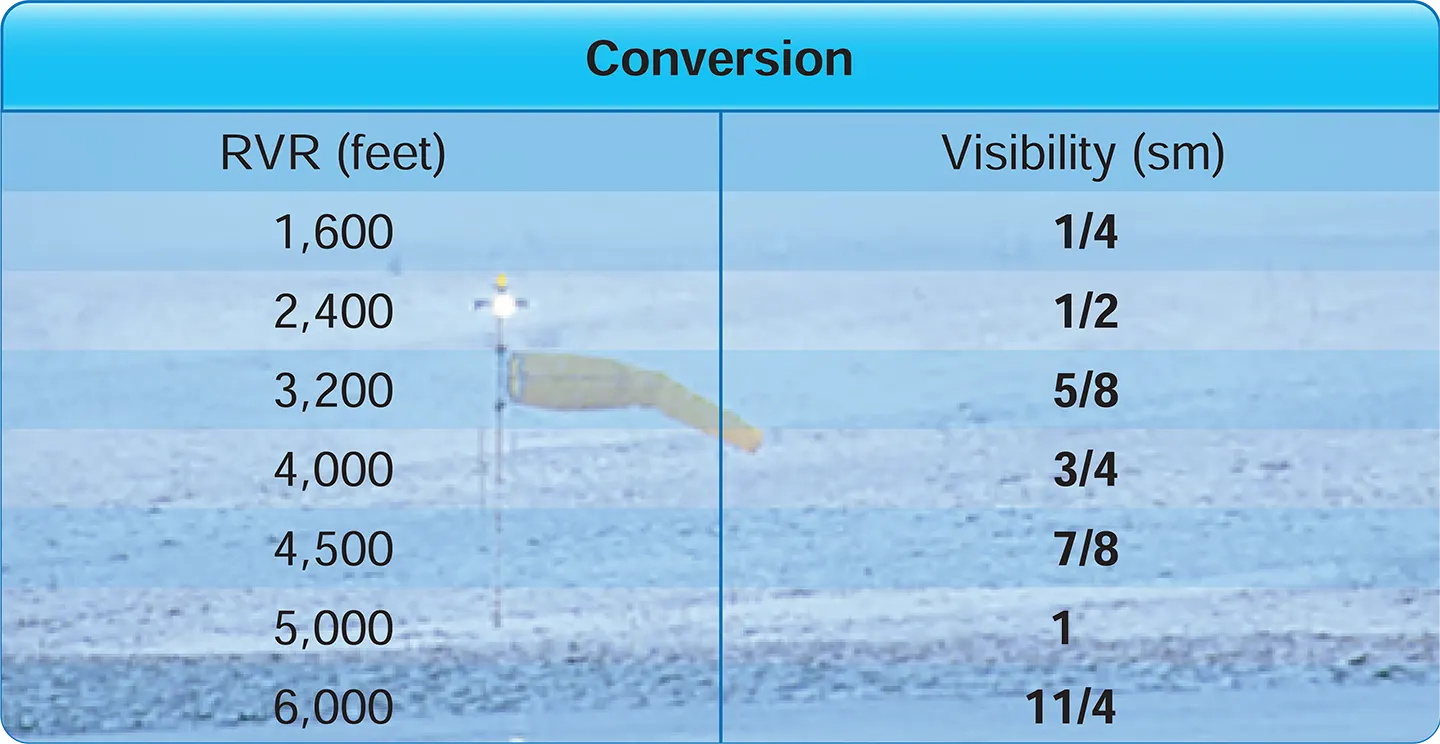
RVR is measured using visibility sensors, including transmissometers, located near runway touchdown zones and, when installed, at other points along the runway. RVR is used in lieu of RVV and/or prevailing visibility when determining minimums for a particular runway. If visibility is reported only in statute miles, RVR values may need to be converted using the applicable conversion table. [Figure 3]
Types of RVR
The following RVR values may be reported, depending on the equipment installed:
- Touchdown RVR—RVR readout values obtained from equipment serving the runway touchdown zone.
- Mid-RVR—RVR readout values obtained from equipment located near the midpoint of the runway.
- Rollout RVR—RVR readout values obtained from equipment located nearest the rollout end of the runway.
- Far End RVR—when four RVR sensors are installed, the far-end sensor is the touchdown-zone sensor for the reciprocal runway. The far-end value provides additional information.
RVR is the primary visibility measurement used by Part 121 and Part 135 operators when specified in their OpSpecs. Operators must obtain the required current RVR reports, when available, before proceeding with an instrument departure. Their OpSpecs also identify which visibility report is controlling in different departure situations.
Adequate Visual Reference
Part 121 and Part 135 operators may also be authorized to use lower-than-standard takeoff minimums under their OpSpecs when certain visibility reports are unavailable or specific equipment is out of service. In these circumstances, departure may still be permitted if the pilot can maintain adequate visual reference and the operator’s authorization permits it.
An appropriate visual aid must be available so that the takeoff surface can be continuously identified and directional control maintained throughout the takeoff run. Visual aids may include high-intensity runway lights, runway centerline lights, runway centerline markings, or other runway lighting and markings. With adequate visual references and the required OpSpec approval, commercial operators may be authorized to take off with visibility as low as 1,600 RVR or ¼ SM.
Ceilings
A ceiling is the height above the Earth’s surface of the lowest cloud layer or obscuring phenomenon reported as broken, overcast, or obscuration, and not classified as thin or partial.
RELATED POSTS