
Jet Airplane Descent and Approach
Descent Planning
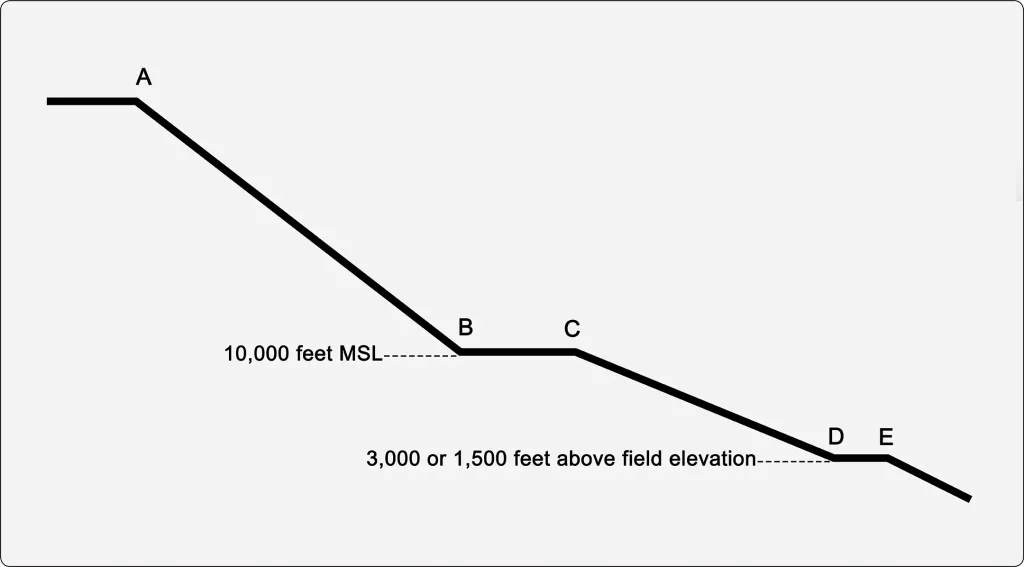
Variables that affect the TOD calculation include:
- Head/tail wind component (adjust distance 1 mile for each 10 knots of wind at cruise altitude),
- Field elevation,
- Terrain considerations,
- Runway alignment on arrival,
- ATC vectors and speed restrictions,
- Type of approach.
Descent Energy Management
There are two forms of energy in an airplane: potential energy in the form of altitude, and kinetic energy in the form of speed. In the normal operating regime at speeds above L/DMAX, increasing speed increases total drag, while a decreasing speed will decrease total drag.
At idle power and at speeds above L/DMAX, increasing speed increases the rate of descent. Sample data for a particular make and model might look like the following:
- 210 KIAS = 1,000 feet per minute
- 250 KIAS = 1,500 feet per minute
- 300 KIAS = 3,000 feet per minute
If speed adjustment is not an option, power can be added to correct a low-energy state, or the speed brakes used to correct a high-energy state. Numerous power fluctuations or repeated deployment and stowing of speed brakes is an indication of either pilot failure to adequately plan and/or manage the descent, or a poorly designed arrival procedure.
If a different descent speed from that planned is used during a descent, an adjustment should be made to the top of descent point. If ahead of schedule, leaving cruise altitude sooner, setting flight idle, and descending at a slower speed will burn less fuel. Conversely, if running late and willing to burn some extra fuel, the pilot can leave cruise later and descend at a higher speed. In all cases, the pilot should check progress during the descent and continue to adjust as necessary.
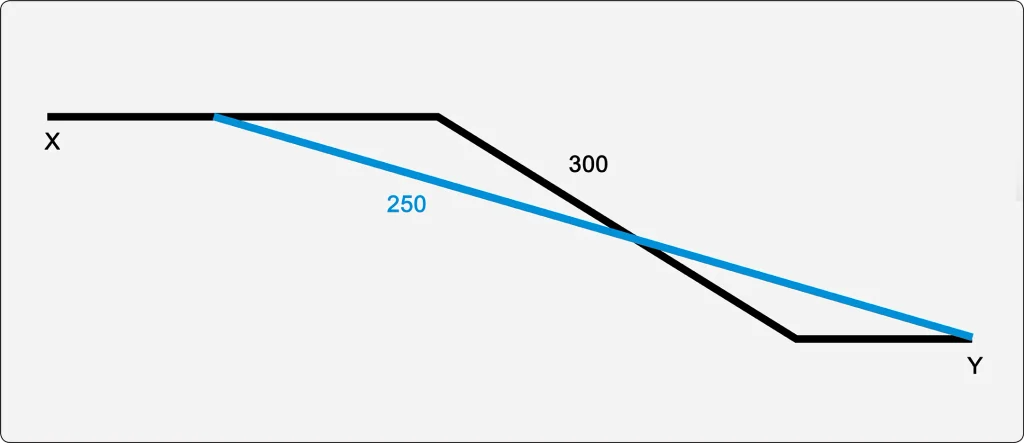
Planned descent speed will affect the position of the planned top of descent point. [Figure 2] In this example, both jets fly past point X at the same cruise speed and altitude with plans to arrive at point Y at 10,000 feet and 250 knots. In both cases, the aircraft would then be in a position to set up a continued descent. The 250-knot descent requires a few miles for deceleration and gives a shallower descent path. The 300-knot descent allows staying at altitude longer, descending at a steeper angle, and then leveling off to slow to 250 knots. The jet that descended at 300 knots arrives first at point Y but burns more fuel. While not depicted, an inefficient descent plan would start the descent at point X, maintain 300 knots, and require power to maintain that airspeed on a shallow descent path.
Jet Engine Landing
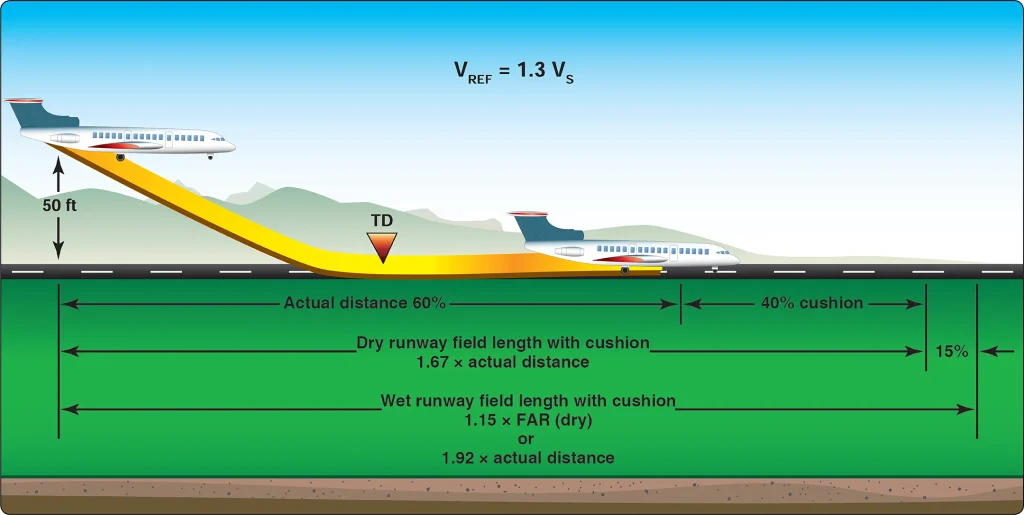
Certified landing field length requirements are computed for the stop made with speed brakes deployed and maximum wheel braking. Reverse thrust is not used in establishing the certified landing distances. However, reversers should definitely be used, if available.
Landing Speeds
- VSO —stall speed in the landing configuration.
- VREF —1.3 times the stall speed in the landing configuration.
- Approach climb—the speed that guarantees adequate performance in a go-around situation with an inoperative engine.
- Landing climb—the speed that guarantees adequate performance in arresting the descent and making a go-around from the final stages of landing with the airplane in the full landing configuration and maximum takeoff power available on all engines.
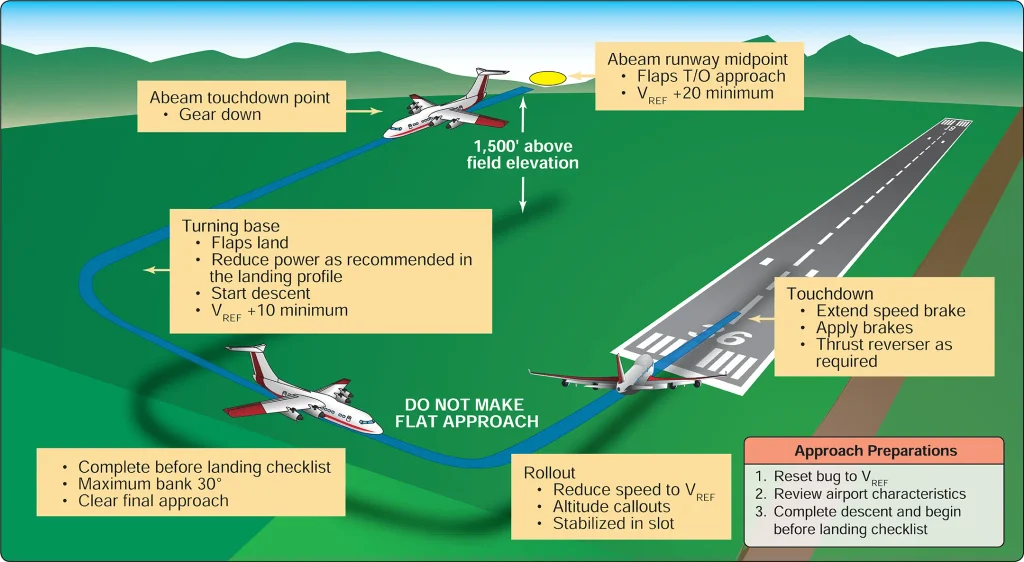
The approach and landing sequence in a jet airplane should be accomplished in accordance with an approach and landing profile developed for the particular airplane. [Figure 4]
Significant Differences
The transitioning pilot should understand that in spite of their impressive performance capabilities, there are many reasons why jet airplanes are less forgiving than piston-engine airplanes during approaches and when correcting approach errors.
- There is no propeller slipstream to produce immediate extra lift at constant airspeed. There is no such thing as salvaging a misjudged glidepath with a sudden burst of power. Added lift can only be achieved by accelerating the airframe.
- Propeller slipstream is not available to lower the power-on stall speed. There is virtually no difference between power-on and power-off stall speed. It is not possible in a jet airplane to jam the thrust levers forward to avoid a stall.
- Jet engine response at low rpm is slower. This characteristic requires that the approach be flown at a stable speed and power setting on final so that sufficient power is available quickly if needed.
- Jet airplanes are consistently heavier and have faster approach speeds than a comparably sized propeller airplane. Since greater force is required to overcome momentum for speed changes or course corrections, the typical jet responds less quickly than the propeller airplane and requires careful planning and stable conditions throughout the approach.
- When the speed does increase or decrease, there is little tendency for the jet airplane to re-acquire the original speed. The pilot needs to make speed adjustments promptly in order to remain on speed.
- Drag increases faster than lift and produces a high sink rate at low speeds. Jet airplane wings typically have a large increase in drag in the approach configuration. When a sink rate does develop, the only immediate remedy is to increase pitch attitude (AOA). Because drag increases faster than lift, that pitch change rapidly contributes to an even greater sink rate unless a significant amount of power is promptly applied.
Stabilized Approach
The basic elements to the stabilized approach are listed below as follows:
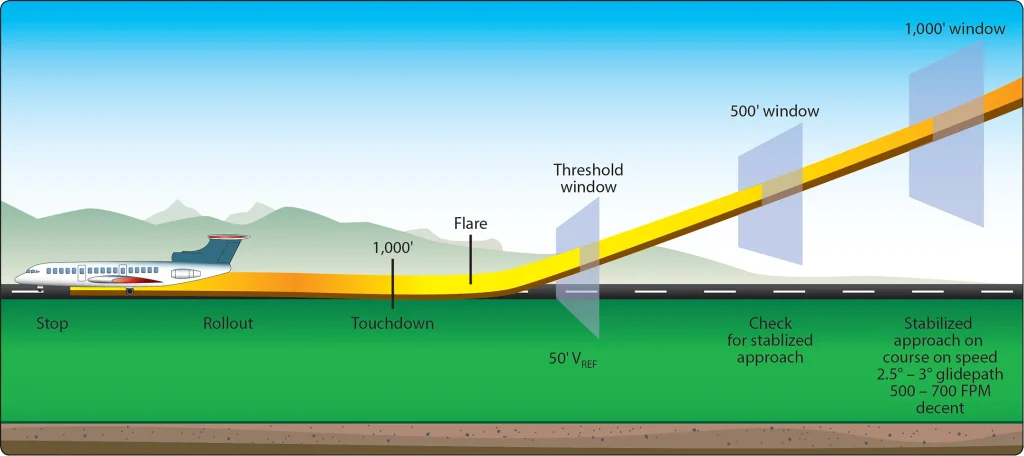
- The airplane should be in the landing configuration by 1,000 feet AGL in the approach. The landing gear should be down, landing flaps selected, trim set, and fuel balanced. Ensuring that these tasks are completed helps keep the number of variables to a minimum during the final approach.
- The airplane should be on profile before descending below 1,000 feet. Configuration, trim, speed, and glidepath should be at or near the optimum parameters early in the approach to avoid distractions and conflicts as the airplane nears the threshold window. An optimum glidepath angle of about 3° should be established and maintained.
- Indicated airspeed should be between zero and 10 knots above the target airspeed by 500 feet AGL. There are strong relationships between trim, speed, and power in most jet airplanes, and it is important to stabilize the speed in order to minimize those other variables.
- The optimum descent rate is dependent upon ground speed. A rule of thumb is to multiply half of ground speed by 10. For example, a 130-knot ground speed should result in a (65 times 10) 650 feet per minute descent rate. Typical descent rates fall between 500 and 700 feet per minute. An excessive vertical speed may indicate a problem with the approach.
Approach Speed
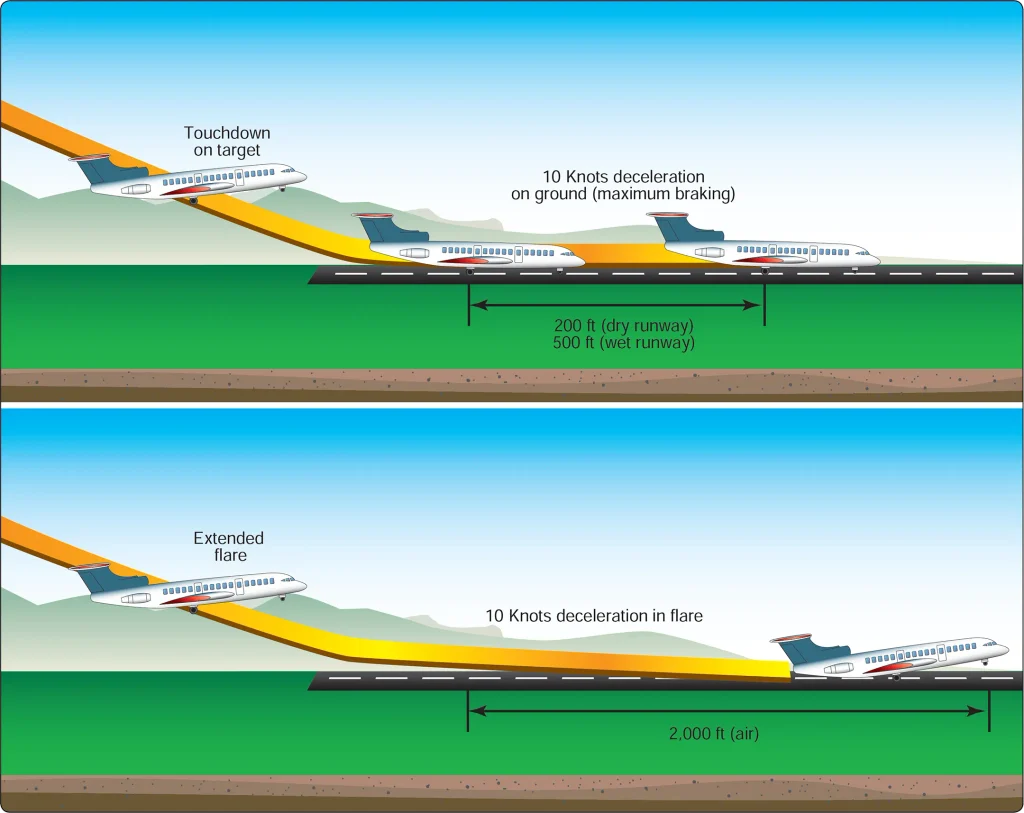
A common error in the performance of approaches in jet airplanes is excess approach speed. Excess approach speed carried through the threshold window and onto the runway increases the minimum stopping distance required by 20–30 feet per knot for a dry runway and 40–50 feet for a wet runway. Worse yet, the excess speed increases the chances of an extended flare, which increases the distance to touchdown by approximately 250 feet for each excess knot in speed.
Proper speed control on final approach is of primary importance. The pilot should anticipate the need for speed adjustment so that only small adjustments are required, and the airplane arrives at the approach threshold window exactly on speed.
Glidepath Control
A more common error is excessive height over the threshold. This could be the result of an unstable approach or a stable but high approach. It also may occur during a nonprecision instrument approach where the missed approach point is close to or at the runway threshold. Regardless of the cause, excessive height over the threshold most likely results in a touchdown beyond the normal aiming point. An extra 50 feet of height over the threshold adds approximately 1,000 feet to the landing distance. The airplane should arrive at the approach threshold window exactly on altitude (50 feet above the runway).
The Flare
For most airports, the airplane passes over the end of the runway with the landing gear 30–45 feet above the surface, depending on the landing flap setting and the location of the touchdown zone. It takes 5–7 seconds from the time the airplane passes the end of the runway until touchdown. The flare is initiated by increasing the pitch attitude just enough to reduce the sink rate to 100–200 fpm when the landing gear is approximately 15 feet above the runway surface. In most jet airplanes, this requires a pitch attitude increase of only 1° to 3°. The thrust is smoothly reduced to idle as the flare progresses.
The normal speed bleed off during the time between passing the end of the runway and touchdown is just a few knots. Most of the decrease occurs during the flare when thrust is reduced. If the flare is extended (held off) while an additional speed is bled off, hundreds or even thousands of feet of runway may be used up. [Figure 6] The extended flare also results in additional pitch attitude, which may lead to a tail strike. It is, therefore, essential to fly the airplane onto the runway at the target touchdown point, even if the speed is excessive. A deliberate touchdown should be planned and practiced on every flight. A positive touchdown helps prevent an extended flare.
Beginning the flare too high or reducing the thrust too early may result in the airplane floating beyond the target touchdown point or may include a rapid pitch up as the pilot attempts to prevent a high sink rate touchdown. This can lead to a tail strike. The flare that is initiated too late may result in a hard touchdown.
Proper thrust management through the flare is also important. In many jet airplanes, the engines produce a noticeable effect on pitch trim when the thrust setting is changed. A rapid change in the thrust setting requires a quick elevator response. If the thrust levers are moved to idle too quickly during the flare, the pilot may need to make rapid changes in pitch control. If the thrust levers are moved more slowly, the elevator input can be more easily coordinated.
Touchdown and Rollout
At the point of touchdown, the airplane represents a very large mass that is moving at a relatively high speed. The large total energy gets dissipated by the brakes, the aerodynamic drag, and the thrust reversers (if available). The nose-wheel should be lowered onto the ground immediately after touchdown because a jet airplane decelerates poorly when held in a nose-high attitude, and placing the nose-wheel tire(s) on the ground assists in maintaining directional control. Lowering the nose gear decreases the wing AOA, decreasing the lift, placing more load onto the tires, thereby increasing tire-to-ground friction. Landing distance charts for jet airplanes assume that the nose-wheel is lowered onto the runway within 4 seconds of touchdown.
There are only three forces available for stopping the airplane: wheel braking, reverse thrust, and aerodynamic braking. Of the three, the brakes are most effective and therefore the most important stopping force for most landings. When the runway is very slippery, reverse thrust and drag may be the dominant forces. Both reverse thrust and aerodynamic drag are most effective at high speeds. Neither is affected by runway surface conditions. Brakes, on the other hand, are most effective at low speed. The landing rollout distance depends on the touchdown speed, what forces are applied, and when they are applied. The pilot controls the what and when factors, but the maximum braking force may be limited by tire-to-ground friction.
The pilot should begin braking as soon after touchdown and wheel spin-up as possible, and smoothly continue the braking until stopped or a safe taxi speed is reached. However, caution should be used if the airplane is not equipped with a functioning anti-skid system. In such a case, heavy braking can cause the wheels to lock and the tires to skid.
Both directional control and braking utilize tire ground friction. They share the maximum friction force the tires can provide. Increasing either subtracts from the other. Understanding tire ground friction, how runway contamination affects it, and how to use the friction available to maximum advantage is important to a jet pilot.
Spoilers should be deployed immediately after touchdown because they are most effective at high speed. Timely deployment of spoilers increases drag significantly, but more importantly, they spoil much of the lift the wing is creating, thereby causing more of the weight of the airplane to be loaded onto the wheels. The spoilers increase wheel loading, which increases the tire ground friction force making the maximum tire braking forces available.
Like spoilers, thrust reversers are most effective at high speeds and should be deployed quickly after touchdown. However, the pilot should not command significant reverse thrust until the nose-wheel is on the ground. If the reversers deploy asymmetrically resulting in an uncontrollable yaw toward the side with more reverse thrust, the pilot needs whatever nose-wheel steering is available to maintain directional control. When runway length is not a factor, using idle reverse thrust may be adequate.
RELATED POSTS