
Transition to Jet-Powered Airplanes

This section contains an overview of jet powered airplane operations. The information contained in this section is meant to be a useful preparation for, and a supplement to, formal and structured jet airplane qualification training. The intent of this section is to provide information on the major differences a pilot will encounter when transitioning to … Read more
Jet Airplane Systems and Maintenance

All FAA-certificated jet airplanes are certificated under Title 14 of the Code of Federal Regulations (14 CFR) part 25, which contains the airworthiness standards for transport category airplanes. The FAA-certificated jet airplane is a highly sophisticated machine with proven levels of performance and guaranteed safety margins. The jet airplane’s performance and safety margins can only … Read more

Jet Airplane Takeoff and Climb

The following information is generic in nature and, since most civilian jet airplanes require a minimum flight crew of two pilots, assumes a two-pilot crew. If any of the following information conflicts with FAA-approved AFM procedures for a particular airplane, the AFM procedures take precedence. Also, if any of the following procedures differ from the … Read more

Jet Airplane Descent, Approach, and Landing

Jet Airplane Descent and Approach The smoothest and most fuel-efficient descent would be to reduce power to flight idle and slow to L/DMAX. In this scenario, the pilot would descend, level off to decelerate, configure for landing, intercept the final approach, and continue a gradual deceleration until setting power for a stabilized descent on final. … Read more

Pilot Sensations During Jet Flight

Pilots transitioning into jets may notice these general sensations: response differences increased control sensitivity increased tempo of flight In some flight conditions, airspeed changes may occur more slowly than in a propeller airplane. At high altitudes, the reduction in available thrust reduces the ability to accelerate. The long spool-up time required from low throttle settings … Read more

Jet Airplanes Thrust Reversers

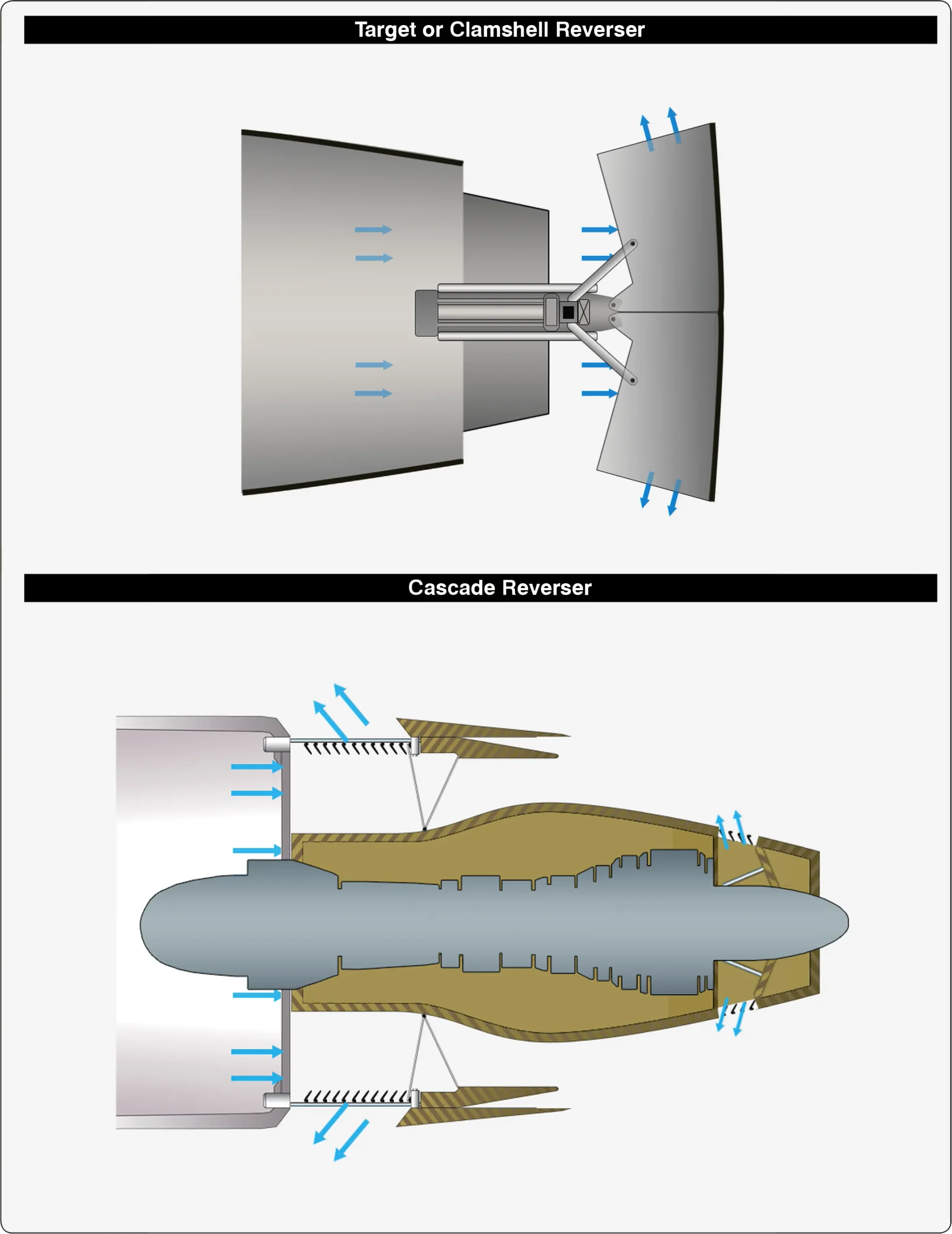
Jet airplanes have high kinetic energy during the landing roll because of weight and speed. This energy is difficult to dissipate because a jet airplane has low drag with the nose-wheel on the ground, and the engines continue to produce forward thrust with the power levers at idle. While wheel brakes serve as the primary … Read more

Jet Airplanes Drag Devices

Jet airplanes have higher glide ratios than piston-powered airplanes. Due to their low drag design, jets take more time and distance to descend or reduce speed. Therefore, jet airplanes are often equipped with drag devices, such as spoilers and speed brakes. The primary purpose of spoilers is to spoil lift. The most common type of … Read more

Jet Airplane Stall Characteristics

The stalling characteristics of the swept wing jet airplane can vary considerably from those of the normal straight wing airplane. The greatest difference noticeable to the pilot is the lift developed vs. angle of attack. An increase in angle of attack of the straight wing produces a substantial and constantly increasing lift vector up to … Read more

Jet Airplane Low Speed Flight

The jet airplane wing, designed primarily for high-speed flight, has relatively poor low-speed characteristics. As opposed to the normal piston-powered airplane, the jet wing has less area relative to the airplane’s weight, a lower aspect ratio (long chord/short span), and thin airfoil shape—all of which amount to the need for speed to generate enough lift. … Read more

Jet Airplane Mach Buffet

Mach buffet arises when airflow separates on the upper surface of a wing behind a shock wave. All other things being equal, shock wave strength increases as the local airflow speed ahead of the shock wave increases. Mach buffet is a function of the speed of the airflow over the wing—not necessarily the forward speed … Read more