
A normal takeoff and initial climb require proper coordination of flight controls, accurate airspeed management, and continuous visual scanning. Pilots must maintain directional control during the takeoff roll, establish the correct lift-off attitude, and transition smoothly into the initial climb. Understanding each phase and recognizing common errors are essential for safe takeoff operations.
Table of Contents
Table of Contents
Normal Takeoff
A normal takeoff is one in which the airplane is headed into the wind. However, there are times when a takeoff with a tailwind may be necessary. The pilot should consult the Pilot’s Operating Handbook (POH) or Airplane Flight Manual (AFM) to ensure that the airplane is approved for a tailwind takeoff and that sufficient performance and runway length are available.
The pilot should also ensure that the takeoff surface is firm and of sufficient length to allow the airplane to accelerate gradually to normal lift-off and climb-out speed, with no obstructions along the takeoff path.
There are two reasons for making a takeoff as nearly into the wind as possible. First, since the airplane depends on airspeed, a headwind provides some of that airspeed even before the airplane begins accelerating into the wind.
Second, a headwind decreases the ground speed necessary to achieve flying speed. Lower ground speeds result in shorter ground roll distances, allowing the use of shorter runways while reducing wear and stress on the landing gear.
Takeoff Roll
For takeoff, the pilot uses the rudder pedals in most general aviation airplanes to steer the nosewheel onto the runway centerline, aligning the airplane with the runway. After releasing the brakes, the pilot should advance the throttle smoothly and continuously to takeoff power.
An abrupt application of power may cause the airplane to yaw sharply to the left because of the torque effects of the engine and propeller. This is most apparent in high-horsepower engines.
As the airplane begins to roll forward, the pilot should ensure that both feet are on the rudder pedals, with the toes or balls of the feet positioned on the rudder portions rather than on the brakes. The engine instruments should be checked for indications of a malfunction during the takeoff roll.
In nosewheel-type airplanes, elevator control pressures are not necessary beyond those required to steady the airplane. Applying unnecessary pressure aggravates the takeoff and prevents the pilot from recognizing when elevator control pressure is actually needed to establish the takeoff attitude.
As the airplane gains speed, the elevator control tends to assume a neutral position if the airplane is correctly trimmed. At the same time, the rudder pedals are used to keep the nose of the airplane pointed down the runway and parallel to the centerline.
The effects of engine torque and P-factor at the initial speeds tend to pull the nose to the left. The pilot should use the rudder pressure needed to correct for these effects or for wind conditions. Aileron controls should be used into any crosswind to keep the airplane centered on the runway.
The pilot should avoid using the brakes for steering, as this slows acceleration, lengthens the takeoff distance, and may result in severe swerving.
As the speed of the takeoff roll increases, more pressure will be felt on the flight controls, particularly the elevators and rudder. If the tail surfaces are affected by the propeller slipstream, they become effective first.
As the speed continues to increase, all flight controls gradually become effective enough to maneuver the airplane about its three axes. At this point, the airplane is being flown more than it is being taxied. As this occurs, progressively smaller rudder deflections are needed to maintain direction.
The feel of resistance to control movement and the airplane’s reaction to those movements are the only real indicators of the degree of control attained. This resistance is not a measure of the airplane’s speed, but rather of its controllability.
To determine the degree of controllability, the pilot should be conscious of the airplane’s reaction to control pressures and immediately adjust those pressures as needed. The pilot should wait for the airplane to react to the applied control pressures and attempt to sense the resistance to pressure rather than trying to control the airplane solely by moving the controls.
A student pilot does not normally have a full appreciation of how control pressures vary with airplane speed. The student may tend to move the controls through wide ranges while seeking the pressures that are familiar and expected. As a consequence, the student may overcontrol the airplane.
This situation may be aggravated by the sluggish reaction of the airplane to these movements. The flight instructor should help the student learn the proper relationship between control actions and airplane reactions.
The instructor should always emphasize the use of proper outside references to judge airplane motion. During takeoff, the student should look far down the runway at two points aligned with the runway.
The flight instructor should have the student pilot follow through lightly on the controls, feel for resistance, and identify the outside references that provide clues about the amount of control movement needed and how control pressure and airplane response change as airspeed increases.
With practice, the student pilot should become familiar with the airplane’s response to acceleration up to lift-off speed, the corrective control movements needed, and the outside references necessary to accomplish the takeoff maneuver.
Lift-Off
Since a good takeoff depends on the proper takeoff attitude, it is important to know how this attitude appears and how it is attained. The ideal takeoff attitude requires only minimal pitch adjustments shortly after the airplane lifts off to attain the speed for the best rate of climb (VY). [Figure 1]
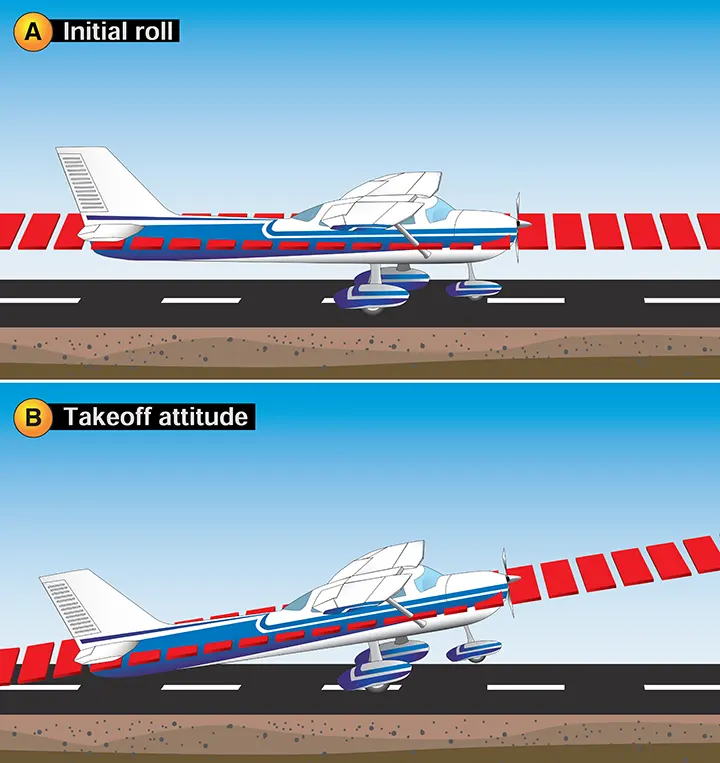
The pitch attitude necessary for the airplane to accelerate to VY should be demonstrated by the instructor and memorized by the student. Flight instructors should be aware that initially, the student pilot may tend to hold excessive back-elevator pressure just after lift-off, resulting in an abrupt pitch-up.
Each type of airplane has a best pitch attitude for normal lift-off. However, varying conditions may require different takeoff techniques. A rough field, smooth field, hard-surface runway, or short or soft, muddy field may each call for a slightly different technique. Smooth air also requires a different technique from strong, gusty wind conditions.
When all flight controls become effective during the takeoff roll in a nosewheel-type airplane, the pilot should gradually apply back-elevator pressure to raise the nosewheel slightly off the runway, thereby establishing the takeoff or lift-off attitude. This is the “rotation” for lift-off and climb.
As the airplane lifts off the surface, the pitch attitude required to maintain climb airspeed should be held with elevator control and trimmed to maintain that attitude without excessive control pressures. The wings should be leveled after lift-off, and the rudder should be used to ensure coordinated flight.
After rotation, the slightly nose-high pitch attitude should be held until the airplane lifts off. Rudder control should be used to maintain the airplane’s track along the runway centerline until any required crab angle in level flight is established.
Forcing the airplane into the air by applying excessive back-elevator pressure results in an excessively high pitch attitude and may delay the takeoff. As discussed earlier, excessive and rapid changes in pitch attitude result in proportionate changes in the effects of torque, making the airplane more difficult to control.
Although the airplane can be forced into the air, this is considered an unsafe practice and should be avoided under normal circumstances. If the airplane is forced to leave the ground by using too much back-elevator pressure before adequate flying speed is attained, the wing’s angle of attack (AOA) may become excessive, causing the airplane to settle back onto the runway or even stall.
On the other hand, if sufficient back-elevator pressure is not maintained to hold the correct takeoff attitude after becoming airborne, or if the nose is allowed to lower excessively, the airplane may also settle back onto the runway. This occurs because the AOA decreases and lift diminishes to the point where it cannot support the airplane.
It is important, therefore, to hold the correct attitude constant after rotation or lift-off.
As the airplane leaves the ground, the pilot should keep the wings level and hold the proper pitch attitude. Outside visual scanning should be intensified at this critical point to attain and maintain the proper pitch and bank attitudes.
Due to the minimum airspeed, the flight controls are not as responsive, requiring more control movement to achieve the expected response. A novice pilot often tends to fixate on the airplane’s pitch attitude and/or the airspeed indicator while neglecting bank control.
Engine torque tends to impart a rolling force that is most evident as the landing gear leaves the surface.
During takeoffs in strong, gusty winds, it is advisable to obtain an extra margin of speed before allowing the airplane to leave the ground. A takeoff at the normal takeoff speed may result in a lack of positive control or a stall when the airplane encounters a sudden lull in strong, gusty winds or other turbulent air currents.
In this case, the pilot should allow the airplane to remain on the ground longer to attain more speed, then make a smooth, positive rotation to leave the ground.
Initial Climb
Upon lift-off, the airplane should be flying at approximately the pitch attitude that allows it to accelerate to VY. This is the speed at which the airplane gains the most altitude in the shortest period of time.
If the airplane has been properly trimmed for takeoff, some back-elevator pressure may be required to hold this attitude until the proper climb speed is established. Relaxing back-elevator pressure before this time may result in the airplane settling, even to the extent that it contacts the runway.
The airplane’s speed will increase rapidly after it becomes airborne. Once a positive rate of climb is established, the pilot should retract the flaps and landing gear, if equipped.
It is recommended that takeoff power be maintained until reaching an altitude of at least 500 feet above the surrounding terrain or obstacles. The combination of VY and takeoff power assures the maximum altitude gained in a minimum amount of time. This gives the pilot more altitude from which the airplane can be safely maneuvered in the event of an engine failure or other emergency.
The pilot should also consider flying at a lower pitch attitude for a cruise climb, since flying at VY requires much quicker pilot response in the event of a powerplant failure to prevent a stall.
Since the power during the initial climb is set at the takeoff power setting, airspeed should be controlled by making slight pitch adjustments using the elevators. However, the pilot should not fixate on the airspeed indicator when making these pitch changes, but should continue to scan outside to adjust the airplane’s attitude in relation to the horizon.
In accordance with the principles of attitude flying, the pilot should first make the necessary pitch change with reference to the natural horizon, hold the new attitude momentarily, and then glance at the airspeed indicator to verify whether the new attitude is correct.
Due to inertia, the airplane will not accelerate or decelerate immediately as the pitch is changed. It takes time for the airspeed to change.
If the pitch attitude has been overcorrected or undercorrected, the airspeed indicator will show a speed that is higher or lower than desired. When this occurs, the cross-checking and appropriate pitch-changing process should be repeated until the desired climbing attitude is established.
Pilots should remember that the climb pitch will be lower when the airplane is heavily loaded or when power is limited by density altitude.
When the correct pitch attitude has been attained, the pilot should hold it constant while cross-checking it against the horizon and other outside visual references. The airspeed indicator should be used only as a check to determine whether the attitude is correct.
After the recommended climb airspeed has been established and a safe maneuvering altitude has been reached, the pilot should adjust the power to the recommended climb setting and trim the airplane to relieve control pressures. This makes it easier to hold a constant attitude and airspeed.
During the initial climb, it is important that the takeoff path remain aligned with the runway to avoid drifting into obstructions or into the path of another aircraft that may be taking off from a parallel runway.
A flight instructor should help the student identify two points in line ahead of the runway to use as a tracking reference. As long as those two points remain in line, the airplane is maintaining the desired track.
Proper scanning techniques are essential to a safe takeoff and climb, not only for maintaining attitude and direction, but also for avoiding collisions near the airport.
When the student pilot nears the solo stage of flight training, it should be explained that the airplane’s takeoff performance will be significantly different when the instructor is not in the airplane.
Due to the decreased load, the airplane will become airborne earlier and climb more rapidly. The pitch attitude that the student has learned to associate with the initial climb may also differ due to the decreased weight, and the flight controls may seem more sensitive.
If the situation is unexpected, it may result in increased anxiety that may remain until after the landing. Frequently, this anxiety and the uncertainty that develops from the perception of an “abnormal” takeoff result in poor performance during the subsequent landing.
Common Errors
Common errors in the performance of normal takeoffs and departure climbs include:
- Failure to review the AFM/POH and performance charts before takeoff.
- Failure to adequately clear the area before taxiing into position on the active runway.
- Abrupt use of the throttle.
- Failure to check engine instruments for signs of malfunction after applying takeoff power.
- Failure to anticipate the airplane’s left-turning tendency during initial acceleration.
- Overcorrecting for the left-turning tendency.
- Relying solely on the airspeed indicator rather than developing an understanding of visual references and tracking clues that indicate airplane airspeed and controllability during acceleration and lift-off.
- Failure to attain the proper lift-off attitude.
- Inadequate compensation for torque/P-factor during the initial climb, resulting in a sideslip.
- Overcontrolling the elevators during the initial climb-out and failing to trim the airplane.
- Limiting the scan to areas directly ahead of the airplane (pitch attitude and direction), causing a wing, usually the left, to drop immediately after lift-off.
- Failure to attain or maintain best rate-of-climb airspeed (VY) or the desired climb airspeed.
- Failure to employ the principles of attitude flying during climb-out, resulting in “chasing” the airspeed indicator.