
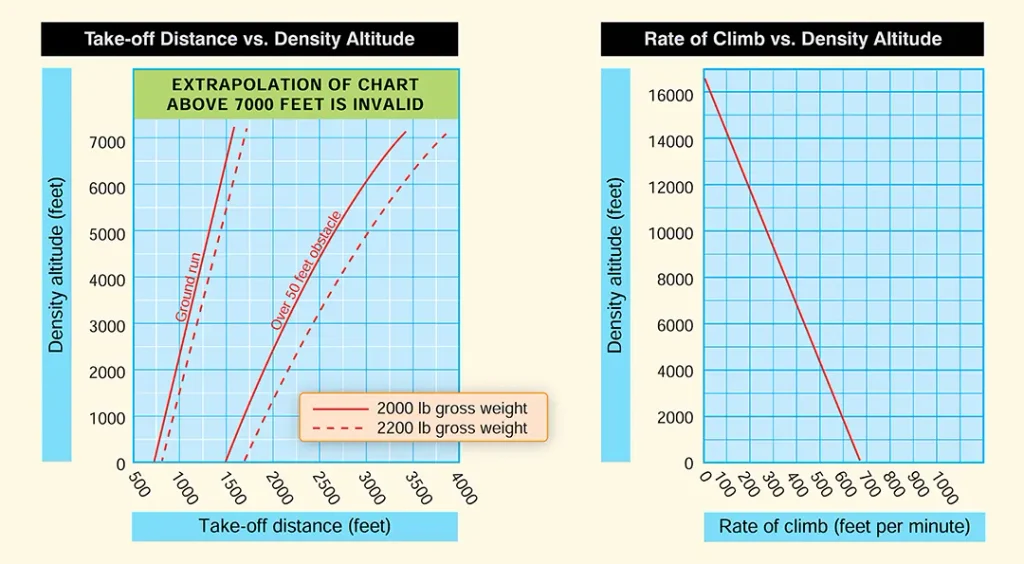
Before going to the airplane, the pilot should check the POH/AFM performance charts to determine the predicted performance and decide if the airplane is capable of a safe takeoff and climb for the conditions and location. [Figure] High density altitudes reduce engine and propeller performance, increase takeoff rolls, and decrease climb performance. A more detailed discussion of density altitude and how it affects airplane performance can be found in the Aeronautical Knowledge section.
Taking off immediately behind another aircraft, particularly a large and heavy transport airplane, creates the risk of a wake turbulence encounter, and a possible loss of control. However, if an immediate takeoff behind a large heavy aircraft is necessary, the pilot should plan to minimize the chances of flying through an aircraft’s wake turbulence by avoiding the other aircraft’s flightpath or rotating prior to the point at which the preceding aircraft rotated. While taxiing onto the runway, the pilot should select ground reference points that are aligned with the runway direction to aid in maintaining directional control and alignment with the runway center line during the climb out. These may be runway centerline markings, runway lighting, distant trees, towers, buildings, or mountain peaks.