
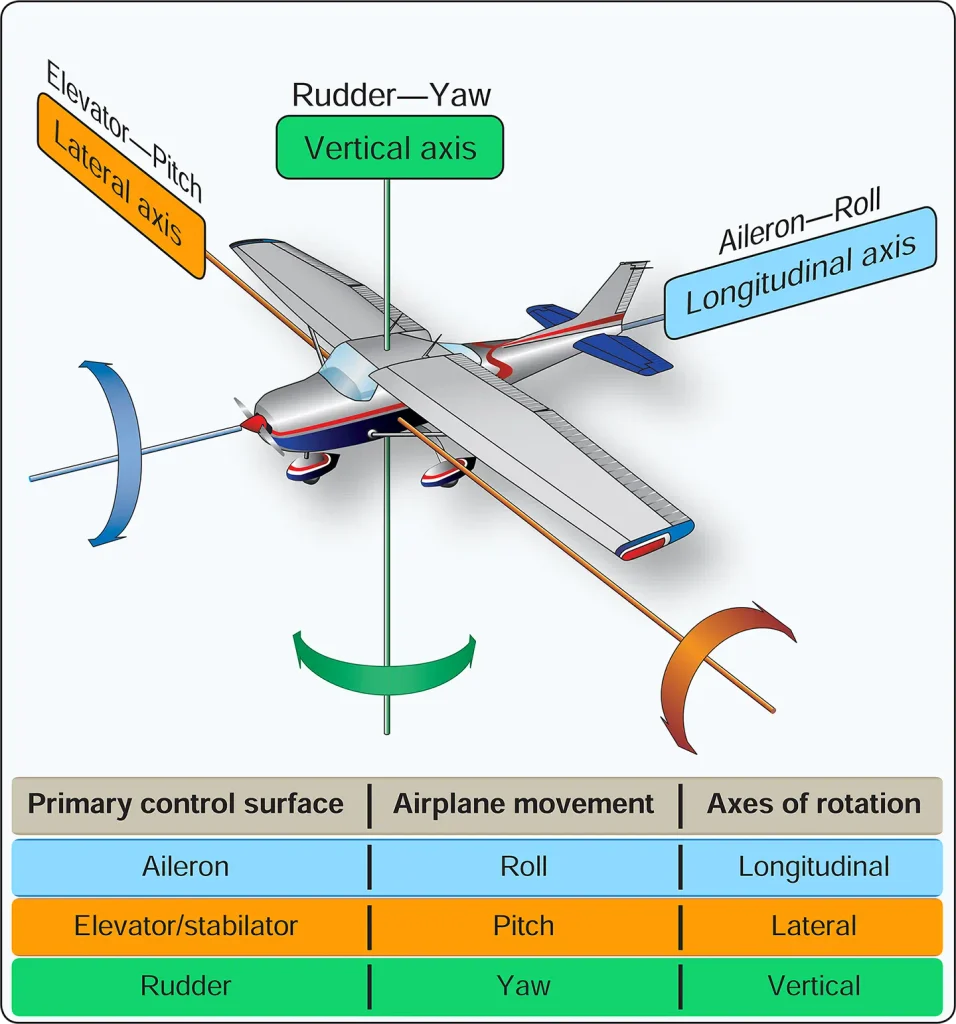
An airplane can move up, down, left, and right relative to the surrounding environment. However, the effect of a control input on the airplane’s flight path depends on its attitude and flight condition. In normal, upright flight, moving the elevator control forward commands a nose-down pitching motion, while moving it aft commands a nose-up pitching motion. When the airplane is inverted, the relationship between pitch attitude and the resulting flight path differs. [Figure 1]
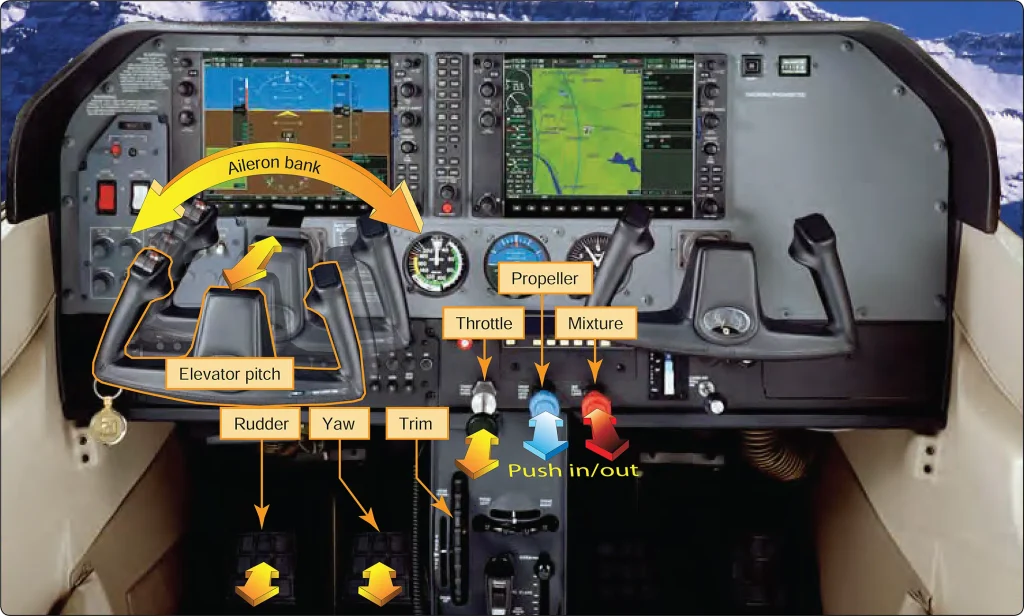
The following discussion explains the effects of flight control inputs from the pilot’s frame of reference. [Figure 2]
Using the pilot’s hands:
- When the pilot pulls the elevator control toward themselves, moving the control wheel, yoke, control stick, or side-stick aft, the input is commonly referred to as applying back pressure. In normal, upright flight, this commands the airplane’s nose to pitch up about its lateral (pitch) axis. Think of the nose moving upward relative to the pilot’s body, from the feet toward the head.
- When the pilot pushes the elevator control toward the instrument panel, the input is commonly referred to as applying forward pressure. In normal, upright flight, this commands the airplane’s nose to pitch down about its lateral (pitch) axis. Think of the nose moving downward relative to the pilot’s body, from the head toward the feet.
- When the pilot applies right aileron control input by rotating the control wheel or yoke clockwise, or moving the control stick or side-stick to the right, the airplane rolls to the right, lowering its right wing relative to its left wing. Think of the right wing moving downward relative to the pilot’s body, toward the right hip.
- When the pilot applies left aileron control input by rotating the control wheel or yoke counterclockwise, or moving the control stick or side-stick to the left, the airplane rolls to the left, lowering its left wing relative to its right wing. Think of the left wing moving downward relative to the pilot’s body, toward the left hip.
Using the pilot’s feet:
- When the pilot presses the right rudder pedal forward, the rudder typically deflects to the right, causing the airplane’s nose to yaw to the right. Think of the nose moving from the pilot’s left shoulder toward the right shoulder.
- When the pilot presses the left rudder pedal forward, the rudder typically deflects to the left, causing the airplane’s nose to yaw to the left. Think of the nose moving from the pilot’s right shoulder toward the left shoulder.
The exact response to a control input depends on the airplane’s design and flight condition.
During flight, aerodynamic forces act on the control surfaces. These forces vary with airspeed, control-surface deflection, and other flight conditions. As airspeed increases, the aerodynamic forces opposing control-surface movement generally increase. As airspeed decreases, these forces generally decrease. The forces also vary with the amount and direction of control-surface deflection.
When maneuvering an airplane, the pilot must consider both the amount of control movement and the pressure required to achieve the desired response. Developing a feel for control pressures helps the pilot make smooth, precise inputs without overcontrolling the airplane.
The pilot should hold the pitch and roll controls—the control wheel, yoke, control stick, or side-stick—lightly and avoid gripping them tightly. Small, smooth control inputs help the pilot sense changes in control pressure and avoid unnecessary movements. A common error among beginning pilots is gripping the controls too firmly, which reduces sensitivity to subtle control forces and can lead to overcontrolling. Developing a light, relaxed grip is an important part of learning to control an airplane smoothly.
To sense small changes in rudder pressure, the pilot should support the weight of both feet on the floor with the balls of the feet resting on the rudder pedals. The legs and feet should remain relaxed. Rudder pressure should be applied smoothly and progressively with the ball of the appropriate foot. Depending on the airplane’s rudder-control system, movement of one pedal may cause the opposite pedal to move. The pilot should avoid applying unnecessary pressure to the opposite pedal and should maintain coordinated control inputs.
In summary, the pilot uses the ailerons, elevator, and rudder to control the airplane’s rotation about its longitudinal (roll), lateral (pitch), and vertical (yaw) axes, respectively. When a control surface moves away from its neutral or streamlined position, the airflow produces aerodynamic forces that influence the airplane’s motion and may be felt through the controls.
Feel of the Airplane
The ability to recognize aspects of an airplane’s flight condition, such as straight-and-level flight, a climb, or a descent, through sensory cues is often called “feeling the airplane.” These cues may include the sound of airflow over the airframe, vibrations transmitted through the controls, changes in engine and propeller sounds, and physical sensations caused by acceleration.
Humans perceive movement and body position through several sensory systems, including kinesthesis and proprioception. Kinesthesis refers to the perception of body movement, while proprioception refers to the awareness of body position and the relative positions of body parts. The vestibular system in the inner ear also contributes to the perception of movement and orientation.
When properly understood, these sensory cues can help pilots recognize changes in an airplane’s motion. However, bodily sensations alone cannot reliably indicate the airplane’s attitude, airspeed, or direction of flight, particularly when external visual references are limited or absent, as in instrument meteorological conditions (IMC). Relying solely on bodily sensations can lead to spatial disorientation and loss of aircraft control. Pilots must rely on appropriate visual references and flight instruments when required.
Developing a feel for an airplane takes time and experience in that particular aircraft. Practice helps pilots become familiar with the sounds, vibrations, and forces associated with different flight conditions. The following examples illustrate some of these cues:
- Airflow noise: Changes in airflow noise may provide clues about changes in airspeed. Increasing noise may accompany increasing airspeed, while decreasing noise may accompany decreasing airspeed. However, airflow noise alone does not reliably indicate airspeed or pitch attitude because it is also affected by aircraft configuration, wind, and other conditions.
- Engine and propeller sounds: Engine and propeller sounds vary with power setting, airspeed, and flight condition. In an airplane equipped with a fixed-pitch propeller, engine RPM and sound may change as airspeed and power change. These changes can provide useful cues, but they should not be used alone to determine pitch attitude or flight condition.
- Changes in loading: During a coordinated, level turn, the pilot generally experiences an increased normal load factor and feels more firmly pressed into the seat. A pull-up maneuver can produce a similar increase in normal load factor. Conversely, reduced normal load factor can make the pilot feel lighter in the seat. These sensations indicate changes in loading but do not, by themselves, identify the airplane’s attitude or maneuver.
Actual sensations of airplane motion are associated with acceleration, which is the rate of change of velocity in magnitude, direction, or both. Acceleration produces forces on the airplane and its occupants. For example, the pilot may feel changes in vertical loading through pressure against the seat or lateral forces when the airplane slips or skids. Even relatively small, perceptible changes can provide useful information about the airplane’s motion.
An experienced pilot may recognize subtle changes in these sensory cues. Nevertheless, sensory perception has limitations, and the pilot should not substitute bodily sensations for reliable visual references or flight instruments.
The flight instructor should teach students to recognize and interpret sounds, vibrations, and physical forces rather than merely notice them. Understanding what these cues may indicate—and recognizing their limitations—helps students develop a useful feel for the airplane. Learning to interpret sensory cues early in flight training can support the development of smoother control inputs and more effective aircraft handling during advanced training.