
Starting, Taxiing, and Run-up
After starting the engine and when ready to taxi, the pilot turns the taxi or landing light ON. In some airplanes, continuous use of the landing light while taxiing may place an excessive drain on the airplane’s electrical system. Also, overheating of some types of landing lights is possible because of inadequate airflow to carry the heat away. If overheating or electrical power is an issue, the landing light may be used only if necessary. When using lights, consideration should be given to not blinding other pilots. Pilots should taxi slowly, particularly in congested areas. If taxi lines are painted on the ramp or taxiway, following the lines ensures a proper path along the route. An instrument check should be done while taxiing to check for proper and correct operation prior to takeoff.
While taxiing for any takeoff, the pilot should verify that the aircraft position, taxi route, and runway for the departure all appear as expected. The taxi diagram, signage, pavement markings, and instruments should all reinforce the pilot’s situational awareness. If any conflicting information or doubt exists, the pilot should not proceed with the taxi or the takeoff. A wrong turn, wrong-surface takeoff, or takeoff on a closed runway can have catastrophic results, and preventing any of these depends on maintaining situational awareness while the aircraft moves on the ground.
When using the checklist for the before-takeoff and run-up checks during the day, any forward movement of the airplane can be detected easily. However, at night, the airplane could creep forward without being noticed unless the pilot takes steps to prevent this possibility. Pilots should hold or lock the brakes during the run-up and be alert for any forward movement.
Takeoff and Climb
After ensuring that the final approach and runway are clear of other air traffic, or when cleared for takeoff by the air traffic controller, the pilot turns the landing and taxi lights ON and lines the airplane up with the centerline of the runway. If the runway does not have centerline lighting, the painted centerline and the distance from the runway edge lights on each side indicate the center. The heading indicator should be noted and correspond or set to the known runway direction. To begin the takeoff, the pilot releases the brakes and advances the throttle smoothly to maximum allowable power. As it accelerates, the airplane should be kept moving straight ahead between and parallel to the runway edge lights.
The procedure for night takeoffs is the same as for normal daytime takeoffs except that many of the runway visual cues are not available. The pilot should check the flight instruments frequently during the takeoff to ensure proper airspeed, attitude, and heading. As the airspeed reaches the normal lift-off speed, the pilot adjusts the pitch attitude to establish a normal climb by referring to both outside visual references, such as lights, and to the flight instruments. [Figure] Without visual references ahead, inexperienced pilots may relax right rudder pressure after takeoff and veer off to the left.
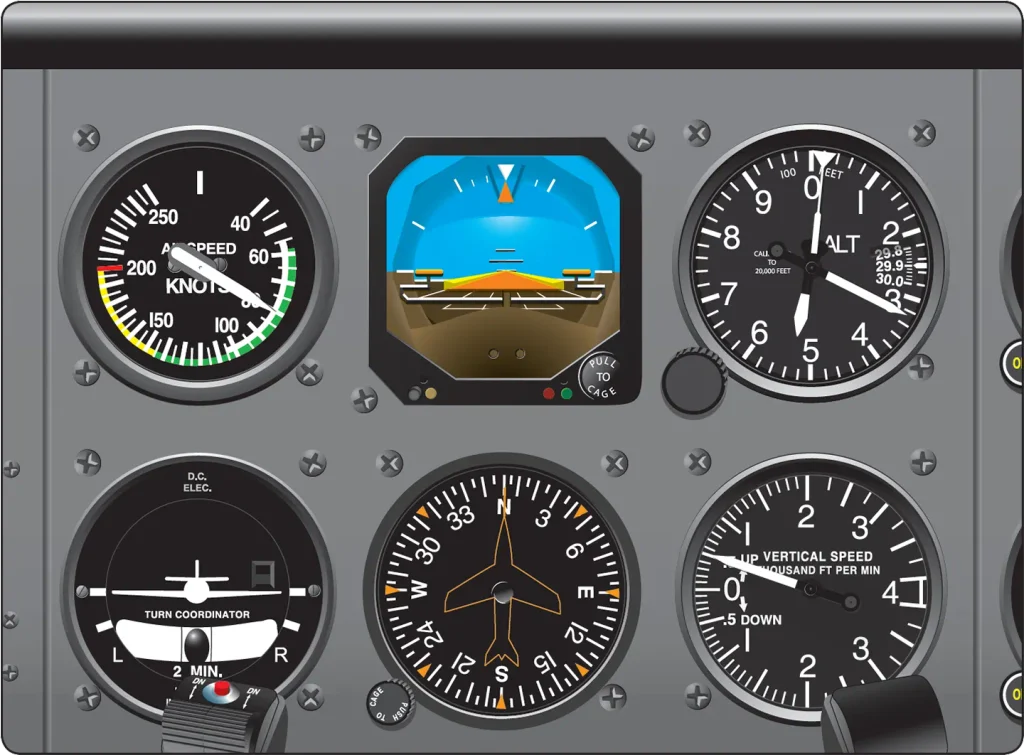
The pilot makes necessary pitch and bank adjustments by referencing the attitude and heading indicators. It is recommended that turns not be made until reaching a safe maneuvering altitude. Although the use of the landing lights is helpful during the takeoff, they become ineffective after the airplane has climbed to an altitude where the light beam no longer extends to the surface. The light can cause distortion when it is reflected by haze, smoke, or clouds that might exist in the climb. Therefore, when the landing light is used for the takeoff, it should be turned off after the climb is well established provided it is not being used for collision avoidance.