Airframe
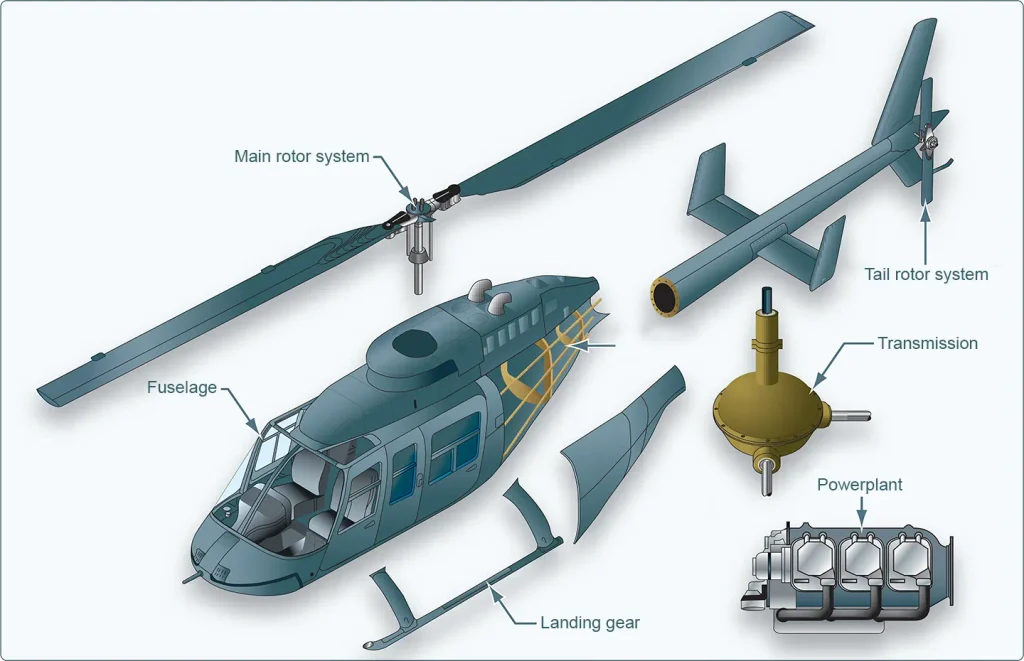
Airframe discussions should explain that the airframe, or structure, of a helicopter can be made of different types of material. Figure 1 is an example of the many different materials that are used in the construction of a helicopter.
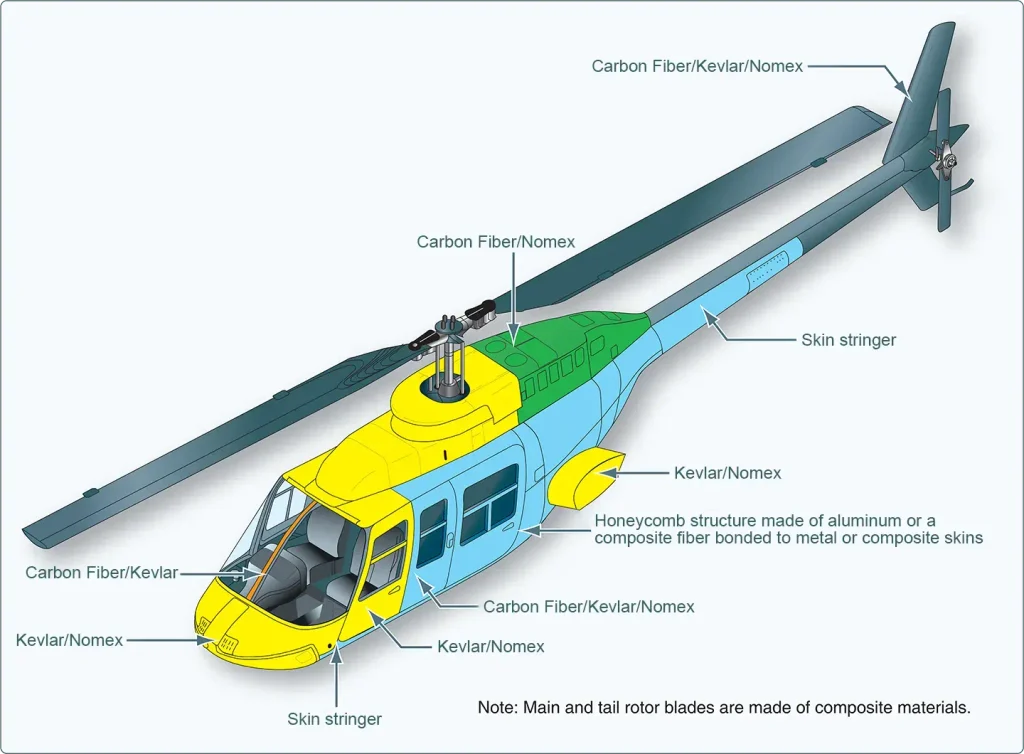
The importance of learning the structures and construction materials of the helicopter is to help the student to determine the airworthiness of the helicopter and potential failures and hazards to be found on pre and post flight inspections. The goal is not to make the pilot into a helicopter aeronautical engineer but rather a safe pilot who can understand the full consequences of an unknown condition of a helicopter component. Helicopters can be made of metal, wood, or composite materials, or a combination of the two. A sample piece of the airframe from the manufacturer is a good prop for introducing the student to the different types of material(s) used. Point out some of the areas that may be made of a variety of materials. One such area is near the exhaust or other areas that must withstand extreme heat for which most manufacturers use titanium. The following is a list of advantages and disadvantages of aluminum and composites that help the student learn about each.
Aluminum
Advantages
- Predictable strength, which is certified by the manufacturer of the metal and which is recorded with each batch.
- The metal conductivity enables a single-wire electrical system to be used, which saves weight and complexity.
- The metal conductivity maximizes antenna reception and transmission.
- Recognized lightning strike properties and protection.
- Minimal UV degradation from sunlight.
- Controllable moisture problems, such as corrosion.
- Will transmit loads and can bend without failure.
- Good bonding techniques can eliminate P-static for better radio reception.
- Smoothness of construction is predetermined; no extensive sanding or filling is required.
- Paint chips do not materially affect the integrity of the underlying aluminum.
- The Federal Aviation Administration (FAA) readily accepts it as a construction medium and is knowledgeable about its physical properties, causing minimal delays in the certification process.
Disadvantages
- Form blocks must be built to hydroform the metal in a soft state, which then has to be heat-treated to regain its strength.
- Due to the setup of the hydro-form process, there is a high per-unit-part cost unless large batches are produced at one time, in which case inventory carrying costs increase.
- Thin aluminum, as used in general aviation aircraft, cannot be compound curved and still carry structural loads, thereby increasing drag in some areas if improperly engineered.
- Antennas need to be exposed for proper operation, necessitating the use of very expensive, low drag antennas for high speed.
- It is almost impossible to build laminar flow wings with the skin thickness used in general aviation aircraft.
- Any flexing of the structure promotes metal fatigue and can suffer from structural failure.
- Operation under certain conditions (ocean salty air, corrosive chemicals found in agricultural operations) can lead to corrosion caused structural failures.
Composite Construction
Advantages
- Ease of construction in small lots. These planes are typically assembled by individuals in their garages.
- Low cost for one-off projects as minimal tooling is required.
- Can be compound curved for maximum drag reduction and still carry structural loads.
- Electronic transparency means antennas can be hidden inside for streamlining without loss of reception.
- Easier to get smooth surfaces for laminar flow designs, which contributes to some additional speed.
- Cracks do not usually propagate in composite structures.
- Structures can be stronger for light weight components.
Disadvantages
- Strength varies from batch to batch. Difficult to detect voids.
- Since there is no metal frame, there is no common ground; a two-wire electrical system is required.
- Without any electrical conductivity, there is very poor lightning strike protection.
- Ultraviolet light degradation due to sunlight.
- Delamination problems due to moisture.
- Composites tend to break without warning at failure loads, unlike aluminum which can bend and still survive, and usually provide some warning prior to failure.
- Poor electrical bonding causes static interference with radios.
- Requires expensive paint maintained in perfect condition (without chips or scratches) to keep sunlight and moisture out; otherwise, composites degrade like an old fiberglass boat. Poor acceptance by the FAA due to unknown physical properties, such as aging and delamination.
- Very labor intensive to construct repeatable components.
- Composites do not afford any fire or heat protection and can be the source of deadly fumes in the case of an accident or fire.
- Composites require new tools and machines to repair.
Fuselage
Perhaps one of the best teaching devices for the fuselage discussion is an actual helicopter.
Better yet is a helicopter with all or most outside panels removed or undergoing major maintenance or inspection. This open view provides an opportunity for the instructor to point out (literally) to the student engine housing, transmission, avionics, flight controls, and the powerplant. Also, the student can view the seating arrangement for your particular helicopter as you identify where the pilot, crew, passengers, and cargo are seated or placed. [Figure 2]